
how to do SEO for website step by step
If you want to learn how to do SEO for website step by step, this complete guide will help you understand everything from basics to advanced strategies. Here you will learn how to optimize your website, improve rankings, and drive organic traffic using modern SEO, AEO, and GEO techniques
- how to do SEO for website step by step
- What is SEO?
- What is Organic Traffic?
- How Search Engines Work?
- SEO vs Paid Ads
- Introduction to Keyword Research
- What is Keyword Research?
- Why Keyword Research is Important
- What is the difference between short-tail and long-tail keywords in SEO?
- Understanding Search Intent
- How to Find Low Competition Keywords?
- Best Keyword Research Tools:-
- Keyword Research Tips (Pro Level)
- Introduction to On-Page SEO
- Introduction to Off-Page SEO
- What is Off-Page SEO?
- Introduction to Technical SEO
- Technical SEO Best Practices
- Introduction to Content SEO
- Examples of Optimized Content Tips
- 5 Best Practices for Content SEO
- Introduction to Local SEO
- Introduction to SEO Tools & Analytics
- Top SEO Tools
- Analytics for SEO
- Introduction to Advanced SEO
- Introduction to AEO
- What is AEO?
- How to Optimize Content for AEO
- AEO Best Practices
- Introduction to GEO
- What is GEO?
- Best Practices for GEO Optimization
- All page overview
What is SEO?
SEO (Search Engine Optimization) is the process of optimizing your website so that it ranks higher on search engines like Google, Bing, or Yahoo.
It includes multiple techniques such as:
- Improving website content
- Using the right keywords
- Optimizing technical structure
- Building backlinks
- Drive organic (free) traffic
- Generate leads or sales
What is Organic Traffic?
Organic traffic means visitors who come to your website through search engines without any paid promotion.
Why organic traffic is important:
- It is completely free
- It brings targeted users
- It builds long-term growth
Example:
If someone searches
“how to do PPC for website step by step”
and your website appears on the first page, users will click and visit your site naturally.
How Search Engines Work?
Search engines like Google follow a process to find and rank websites. This process has three main steps:
1. Crawling
Crawling is the process where search engine bots (also called spiders) visit your website and scan your content.
They check:
- Pages
- Images
- Links
If your website is not crawlable, it will not appear on Google.
2. Indexing
After crawling, Google stores your website data in its database. This process is called indexing.
If your page is indexed:
- It can appear in search results
If not indexed: - It will not show on Google
3. Ranking
Ranking is the process where Google decides which pages to show first.
Google ranks based on:
- Content quality
- Keywords
- User experience
- Backlinks
SEO vs Paid Ads
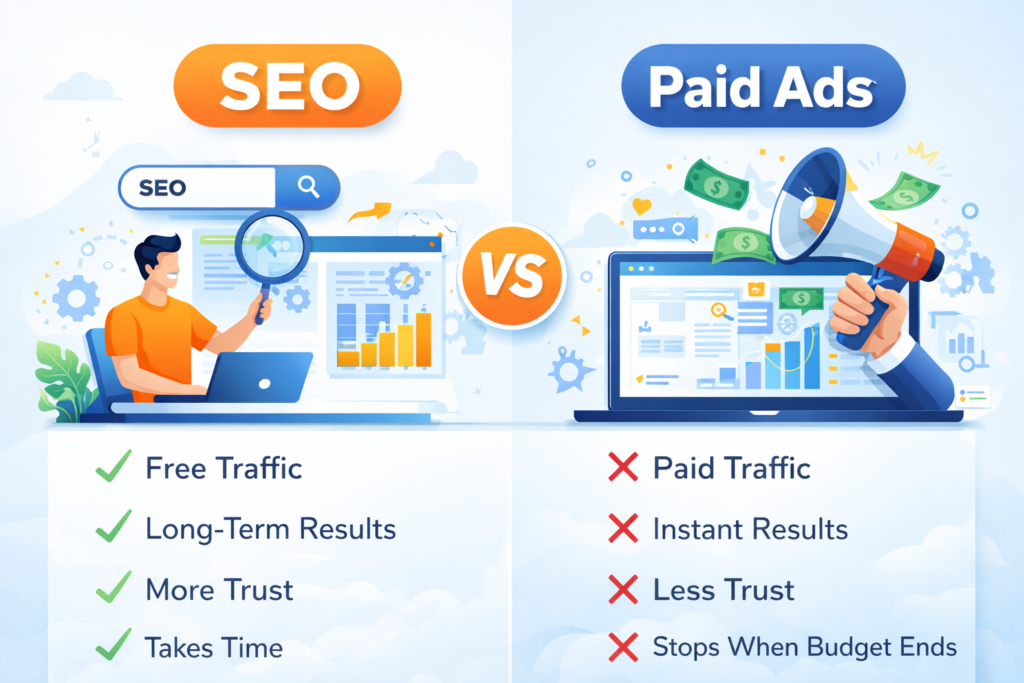
Understanding the difference between SEO and paid ads is very important:
| SEO | Paid Ads |
|---|---|
| Free traffic | You pay for every click |
| Long-term results | Instant results |
| Builds trust and authority | Less trust compared to organic |
| Takes time to grow | Fast but stops when budget end |
Introduction to Keyword Research
If you want to learn how to do SEO for website step by step, keyword research is the most important step. It helps you understand what your audience is searching on Google and how you can create content based on that.
Key Points:
- Keyword = What users search on Google
- Helps target the right audience
- Important for ranking
What is Keyword Research?
Keyword research is the process of finding relevant words and phrases that people use in search engines. By using the right keywords, you can create content that matches user needs and ranks higher.
Key Points:
- Find search terms
- Understand user needs
- Improve content strategy
Why Keyword Research is Important
Keyword research is the foundation of SEO. Without it, your content may not reach the right audience or rank on Google.
Key Points:
- Helps content rank faster
- Brings targeted traffic
- Reduces competition
- Improves SEO strategy
What is the difference between short-tail and long-tail keywords in SEO?
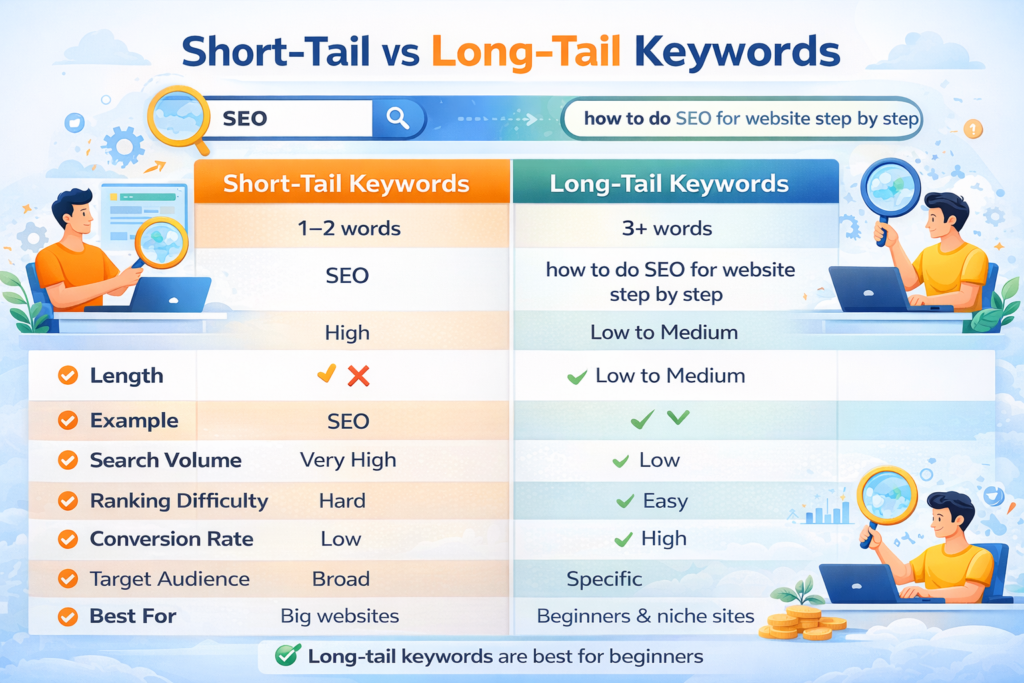
| Feature | Short-Tail Keywords | Long-Tail Keywords |
|---|---|---|
| Length | 1–2 words | 3+ words |
| Example | SEO | how to do SEO for website step by step |
| Search Volume | High | Low to Medium |
| Competition | Very High | Low |
| Ranking Difficulty | Hard | Easy |
| Conversion Rate | Low | High |
| Target Audience | Broad | Specific |
| Best For | Big websites | Beginners & niche sites |
Short-Tail Keywords
Short-tail keywords are general and usually consist of 1–2 words. They have high search volume but also high competition.
Key Points:
- 1–2 words
- High search volume
- High competition
Long-Tail Keywords
Long-tail keywords are more specific and usually contain 3 or more words. These keywords are easier to rank and bring better conversion.
Key Points:
- 3+ words
- Low competition
- High conversion rate
- Best for beginners
Understanding Search Intent
Search intent means the purpose behind a user’s search. Understanding this helps you create the right type of content.
Key Points:
- Why user is searching
- Helps match content with intent
- Improves ranking
Informational Intent
Users want to learn something or get information.
Key Points:
- “What is SEO”
- “How to do PPC”
Transactional Intent
Users want to take action, like buying or subscribing.
Key Points:
How to Find Low Competition Keywords?
Finding low competition keywords helps beginners rank faster and easier.
Key Points:
- Use keyword tools
- Check search volume
- Analyze keyword difficulty
- Choose long-tail keywords
Best Keyword Research Tools:-
Google Keyword Planner
This is a free tool by Google that helps you find keyword ideas and search volume data.
Key Points:
- Free to use
- Keyword ideas
- Search volume data
Ubersuggest
Ubersuggest is a beginner-friendly tool that provides keyword suggestions and SEO data.
Key Points:
- Easy interface
- Keyword difficulty
- Traffic insights
Keyword Research Tips (Pro Level)
Keyword research becomes more powerful when you follow some advanced strategies.
Key Points:
- Focus on long-tail keywords
- Understand user intent
- Avoid high competition keywords
- Use keywords naturally
- Analyze competitors
Introduction to On-Page SEO
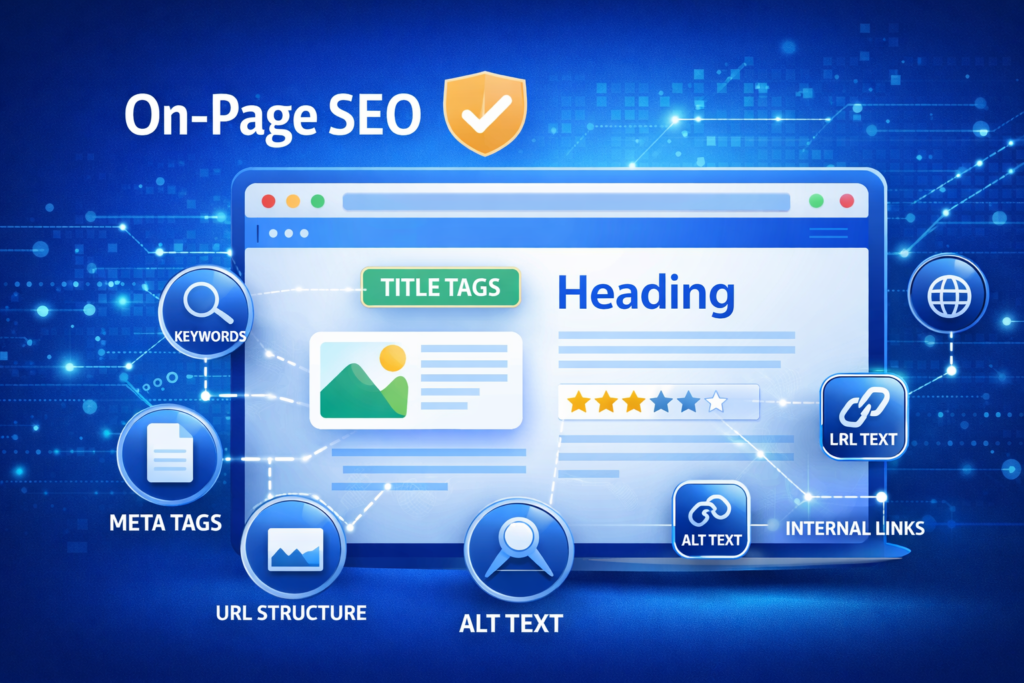
On-page SEO is the practice of optimizing everything inside your website pages to help search engines understand your content and improve user experience.
It ensures that every element on your page — from titles to images — works together to improve your website ranking.
Proper on-page SEO makes your website:
- Easy to read for users
- Easy to understand for search engines
- More likely to appear on top search results
Key Points:
- Focuses on website’s internal elements
- Improves user experience
- Helps search engines understand content
Title Tag Optimization
The title tag is one of the most important on-page SEO elements. It appears in Google search results as the clickable headline. A good title tag encourages clicks and improves your website ranking.
Best Practices:
- Include your main keyword naturally
- Keep it between 50–60 characters
- Make it attractive and clear
- Avoid keyword stuffing
Example:
- Good: “How to Do SEO for Website Step by Step (Beginner Guide)”
- Bad: “SEO SEO SEO website SEO tutorial SEO tips”
Key Points:
- Main keyword should appear early
- Unique title for every page
- Reflects the page content accurately
Meta Description
A meta description is a short paragraph shown below the title in search results. While it doesn’t directly affect ranking, it influences click-through rates (CTR) significantly.
Best Practices:
- Keep it 150–160 characters
- Include your main keyword
- Make it engaging and descriptive
- Clearly explain what users will get
Example:
“Learn how to do SEO for website step by step with our complete beginner-friendly guide. Improve ranking, traffic, and user experience easily.”
URL Structure
A clean URL is easier for users to read and helps search engines understand the page topic. It also appears in search results, so clarity is essential.
Best Practices:
- Keep URLs short and descriptive
- Include main keywords
- Use hyphens instead of underscores
- Avoid special characters or numbers
Heading Structure (H1, H2, H3)
Headings structure your content, making it readable for users and understandable for search engines. Proper heading hierarchy improves SEO and user experience.
Best Practices:
- H1 → Main page title (one per page)
- H2 → Main sections
- H3 → Sub-sections under H2
- Include keywords naturally in headings
Example:
- H1: How to Do SEO for Website Step by Step
- H2: Keyword Research
- H3: Short-Tail vs Long-Tail Keywords
Key Points:
- Organizes content clearly
- Helps Google understand page topics
- Improves readability
Keyword Placements
Using keywords correctly on your page is crucial for ranking. But overusing them can hurt your SEO.
Best Practices:
- Use keyword in title, meta description, and H1
- Include in first paragraph
- Use in H2/H3 headings
- Add in image alt text
- Naturally sprinkle throughout the content
Key Points:
- Avoid keyword stuffing
- Use related keywords and synonyms
- Maintain natural flow for readers
Image Optimization
Images make your content engaging but must be optimized for SEO.
Best Practices:
- Compress images to reduce loading time
- Add descriptive alt text with keywords
- Use proper file names (e.g., seo-step-by-step.png)
- Include captions if needed
Key Points:
- Improves page speed
- Helps Google understand images
- Enhances user experience
Internal Linking
Linking to other pages on your website improves SEO and keeps users engaged.
Best Practices:
- Link to relevant pages naturally
- Use keyword-rich anchor text
- Avoid excessive linking
Key Points:
- Helps spread link authority
- Increases page views
- Improves user navigation
Content Readability
Google favors content that is easy to read. Proper formatting, short paragraphs, and bullet points improve both readability and ranking.
Best Practices:
- Use short sentences and paragraphs
- Include bullet points and numbered lists
- Add headings and subheadings
- Highlight important words
Key Points:
- Improves user experience
- Lowers bounce rate
- Helps SEO and AEO
Mobile-Friendliness & Page Speed
Most users browse via mobile. Google also prioritizes mobile-friendly and fast-loading pages.
Best Practices:
- Use responsive design
- Optimize images and code
- Test loading speed using tools like PageSpeed Insights
Key Points:
- Enhances user experience
- Important for ranking
- Reduces bounce rate
Introduction to Off-Page SEO
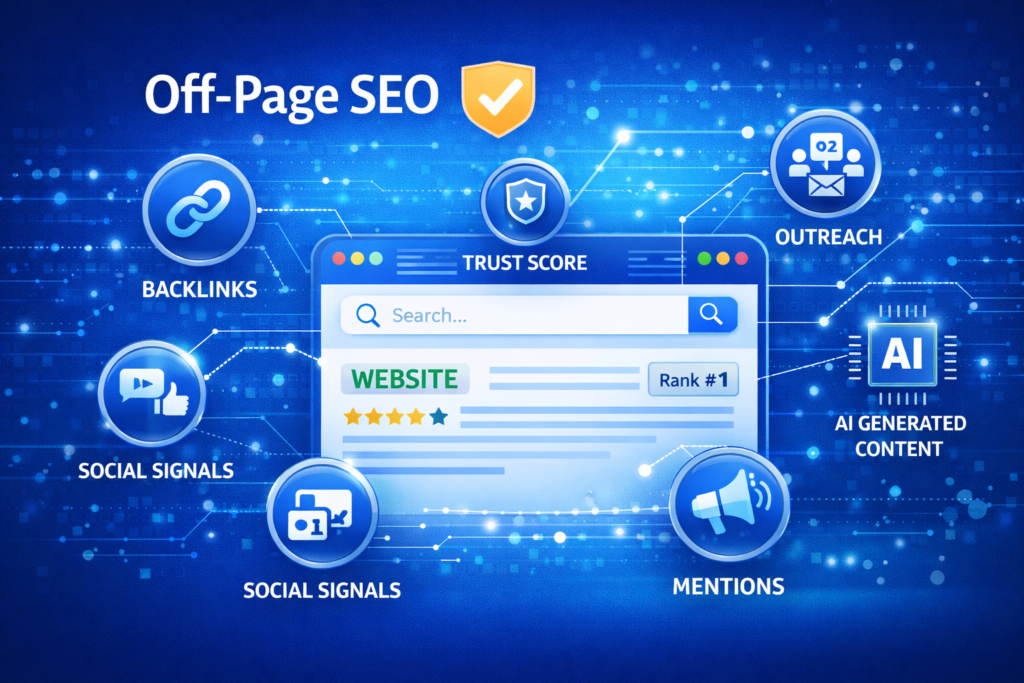
Off-page SEO focuses on improving your website’s authority and trust outside the website itself. By optimizing backlinks, social signals, and guest posting, your website can rank higher on Google, especially for businesses in India or globally.
Key Points:
- Improves website authority and credibility
- Increases search engine ranking for target regions (GEO optimized)
- Supports organic traffic growth (SEO & AEO)
What is Off-Page SEO?
Off-page SEO includes all actions taken outside your website to boost ranking and brand visibility. This is critical if you want your website to rank for “how to do SEO for website step by step” queries locally or globally.
Key Points:
- Focus on backlinks, social signals, and brand mentions
- Boosts website trust in search engines (AEO)
- Essential for improving local and international rankings (GEO)
Backlinks
Backlinks are links from other websites to your site. High-quality backlinks are the most important ranking factor for Google.
Key Points:
- Google treats backlinks as “votes of confidence”
- Quality backlinks from relevant sites boost authority
- Helps drive referral traffic from other websites
| No. | Strategy | Explanation | Example / Tip |
|---|---|---|---|
| 1 | Guest Posting | Write articles for other websites and link back to your site | Post on high-authority blogs in your niche |
| 2 | Resource Page Link Building | Get listed on pages that share resources | Find “SEO resources” pages in your industry |
| 3 | Broken Link Building | Find broken links on websites and offer your link | Use tools like Ahrefs to find broken links |
| 4 | Skyscraper Technique | Create high-quality content and ask sites to link | Make an ultimate guide on SEO, then outreach |
| 5 | Social Media Sharing | Share content on social media to attract backlinks | LinkedIn, Twitter, Facebook posts |
| 6 | Forum & Q&A Participation | Answer questions and include your link where relevant | Quora, Reddit, niche forums |
| 7 | Influencer Outreach | Collaborate with industry influencers for backlinks | Ask influencers to reference your guide |
| 8 | Local Business Listings | List your website on local directories | Google My Business, JustDial (India) |
| 9 | Testimonials & Reviews | Give reviews to get backlinks from other sites | “Testimonial” sections on SaaS tools |
| 10 | Infographics & Visual Content | Share visual content to earn backlinks | Infographics on “On-Page SEO vs Off-Page SEO” |
High-Quality Backlink Building
Not all backlinks are equal. Focus on links from authoritative and relevant sites for better results.
Best Practices:
- Publish shareable, valuable content
- Reach out to reputable websites in your niche or location
- Use niche directories and industry forums
Key Points:
- High-quality links improve trustworthiness
- Relevant links are more powerful for GEO-targeted ranking
- Builds long-term SEO value
Guest Posting
Guest posting allows you to publish content on other websites and link back to your site. This strategy builds backlinks, authority, and drives relevant traffic.
Best Practices:
- Post on high-authority, niche websites
- Provide original, valuable content
- Include natural backlinks pointing to your website
Key Points:
- Increases backlinks for SEO
- Expands your audience
- Enhances regional authority if posting on local sites (GEO)
Social Signals
Social signals are interactions on platforms like Facebook, Twitter, LinkedIn, Instagram, and YouTube. They show search engines that your content is engaging and relevant.
Best Practices:
- Share content on social media regularly
- Engage with users through comments, shares, and likes
- Build a social media presence in your target GEO region
Key Points:
- Improves brand visibility and traffic
- Indirectly boosts ranking (AEO & SEO)
- Helps with local relevance (GEO)
Off-Page SEO Best Practices
Key Points:
- Focus on high-quality, relevant backlinks
- Use guest posting strategically
- Promote content on social media and forums
- Engage with your niche community online
- Avoid spammy or black-hat SEO tactics
Introduction to Technical SEO
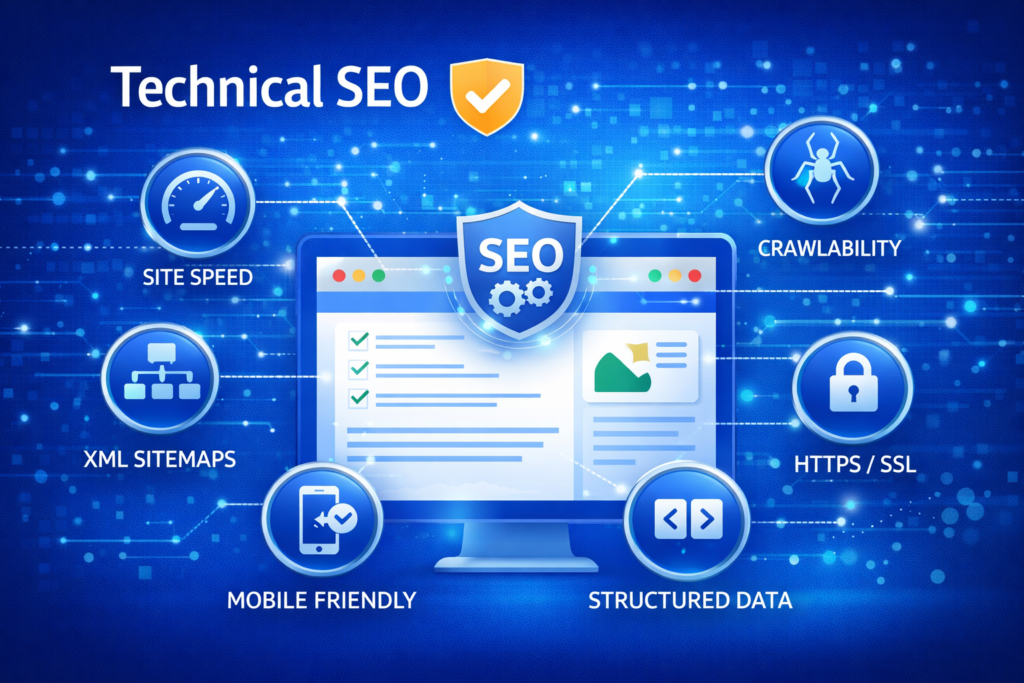
Technical SEO focuses on your website’s technical health to make sure search engines can crawl, index, and understand your website efficiently.
It ensures your website is fast, secure, mobile-friendly, and easy for Google to explore.
Key Points:
- Optimizes website’s technical infrastructure
- Improves crawling and indexing by search engines
- Supports better ranking and user experience
Website Speed Optimization
Page speed is a critical ranking factor. Faster websites provide better user experience and reduce bounce rates.
Best Practices:
- Compress images and use next-gen formats (e.g., WebP)
- Enable browser caching and GZIP compression
- Minify CSS, JavaScript, and HTML
- Use a fast and reliable hosting provider
Key Points:
- Improves SEO ranking
- Enhances user experience
- Important for mobile users (GEO optimization for India & globally)
Mobile-Friendly Design
Most users browse via mobile devices. Google prioritizes mobile-friendly websites in its ranking algorithm (mobile-first indexing).
Best Practices:
- Use responsive design
- Test mobile usability with Google Mobile-Friendly Test
- Ensure buttons, links, and forms are mobile-accessible
Key Points:
- Better ranking in mobile search results
- Improves user experience
- Reduces bounce rate
XML Sitemap
An XML sitemap helps search engines discover and index all pages of your website efficiently.
Best Practices:
- Include all important pages
- Submit sitemap to Google Search Console
- Update it regularly when new pages are added
Key Points:
- Helps search engines crawl your site
- Ensures all pages are indexed
- Supports faster ranking for new pages
Robots.txt
The robots.txt file tells search engines which pages to crawl or avoid. Proper configuration prevents indexing of irrelevant pages.
Best Practices:
- Block non-essential pages (e.g., admin pages)
- Allow important pages to be crawled
- Avoid blocking CSS or JS needed for page rendering
Key Points:
- Controls search engine crawling
- Prevents indexing of duplicate or low-value pages
- Improves technical SEO health
HTTPS Security
HTTPS (SSL certificate) secures your website by encrypting data between the server and users. Google considers HTTPS as a ranking factor.
Best Practices:
- Install an SSL certificate
- Redirect HTTP pages to HTTPS
- Fix mixed content issues
Key Points:
- Builds trust with users
- Improves Google ranking
- Ensures secure data transfer
Technical SEO Best Practices
Other technical SEO optimizations that enhance site performance and ranking:
Key Points:
- Fix broken links (404 errors)
- Implement structured data (Schema.org)
- Monitor crawl errors in Google Search Console
- Optimize server response time
- Keep website architecture simple and logical
Introduction to Content SEO
Content SEO ensures your website content is valuable, readable, and optimized for search engines and users. Content is the most important part of SEO — Google rewards websites that publish high-quality, informative content.
Key Points:
- High-quality content improves ranking
- Content should answer users’ search queries (AEO)
- GEO optimization: Include location references if targeting local searches
Importance of High-Quality Content
High-quality content builds trust with users and search engines. It also encourages backlinks, social shares, and higher engagement.
Best Practices:
- Research your topic thoroughly
- Provide actionable tips or step-by-step guidance
- Include visuals like images, infographics, and charts
Key Points:
- Valuable content = more organic traffic
- Builds authority in your niche
- Supports on-page and off-page SEO
Keyword Usage in Content
Using keywords naturally helps search engines understand your content topic without keyword stuffing.
Best Practices:
- Use your main keyword in title, headings, first paragraph, and naturally throughout content
- Include related keywords and synonyms
- Maintain natural readability
Key Points:
- Helps Google identify content relevance
- Improves ranking for target queries like “how to do SEO for website step by step”
- Avoid over-optimization
Blog Structure:
| Section | Purpose | Tips |
|---|---|---|
| Introduction | Grab attention & explain topic | Include main keyword early |
| Body | Detailed explanation, tips, examples | Use headings, bullet points, images |
| Conclusion | Summarize & call to action | Reinforce main keyword & next steps |
Key Points:
- Clear structure improves user experience
- Headings and subheadings make content scannable
- Supports AEO by answering search intent
Readability Improvement
Readable content keeps users engaged and reduces bounce rate. Google favors easy-to-read content.
Best Practices:
- Use short paragraphs and sentences
- Add bullet points, numbered lists, and tables
- Highlight important words or phrases
- Use images, charts, and infographics
Key Points:
- Improves dwell time on page
- Makes content easier to understand for users
- Indirectly boosts SEO
Examples of Optimized Content Tips
| Section | Keyword Use | Notes |
|---|---|---|
| Title | Include main keyword | Example: “How to Do SEO for Website Step by Step” |
| Meta Description | Include main keyword + related keywords | Engaging & descriptive, 150–160 chars |
| Headings | Use main and related keywords | H1 = main, H2/H3 = related keywords |
| First Paragraph | Include main keyword naturally | Introduces topic clearly |
| Images | Alt text with keyword | Helps Google understand visuals |
| Links | Internal & external | Use descriptive anchor text |
5 Best Practices for Content SEO
- Publish original and valuable content
- Update content regularly to stay relevant
- Use internal linking to other relevant pages
- Add images, videos, and infographics
- Optimize for mobile readability and fast loading
Introduction to Local SEO
Local SEO focuses on optimizing your website and online presence to attract customers in a specific geographic area.
It is especially important for small businesses, local services, and regional online stores.
Key Points:
- Helps local businesses appear in search results
- Optimizes Google Maps and local listings
- GEO optimized for city or region-specific searches
Google My Business (GMB) Optimization
Google My Business (GMB) is one of the most effective ways to appear in local search results.
Best Practices:
- Claim and verify your business listing
- Add accurate business details: Name, Address, Phone (NAP)
- Upload photos, videos, and business hours
- Regularly update posts and offers
Key Points:
- Improves visibility on Google Maps
- Builds trust with local customers
- Increases clicks and visits
Local Keywords
Local keywords help you target customers in your city, region, or country.
Best Practices:
- Use city or region names with your main keyword
- Include in title tags, meta descriptions, headings, and content
- Focus on long-tail local search phrases
Examples:
- “SEO services in Kolkata”
- “How to do SEO for website step by step in India”
Reviews & Ratings
Customer reviews and ratings play a crucial role in local SEO. Google values businesses with positive feedback.
Best Practices:
- Encourage customers to leave reviews on GMB
- Respond to reviews professionally
- Showcase reviews on your website
| No | Element | Purpose | Best Practices | GEO Optimization Tip |
|---|---|---|---|---|
| 1 | Google My Business (GMB) | Appear in Google Maps & local search | Claim & verify your profile, add photos, update hours | Include city/region name in business title & description |
| 2 | Local Keywords | Target regional searches | Use city/region name with main keyword in title, meta, headings, content | Example: “SEO services in Kolkata” |
| 3 | Reviews & Ratings | Build trust & improve local ranking | Encourage reviews, respond professionally, showcase on website | Ask customers from your local area to leave reviews |
| 4 | Local Directories | Increase online visibility | Submit to trusted local listings & citation sites | Use consistent NAP (Name, Address, Phone) across all listings |
| 5 | Structured Data | Help search engines understand business info | Use LocalBusiness schema on website | Include location, business type, and contact info |
| 6 | Mobile Optimization | Improve UX for local visitors | Use responsive design, fast loading pages | Mobile-first optimization for local searches |
| 7 | Local Content | Target location-based search intent | Blog posts, events, offers specific to region | Example: “Best SEO strategies for Kolkata businesses” |
Introduction to SEO Tools & Analytics
SEO tools and analytics are essential for tracking website performance, identifying optimization opportunities, and measuring results.
Without the right tools, it’s difficult to understand how your SEO efforts impact traffic, ranking, and conversions.
Key Points:
- Helps track keyword ranking and organic traffic
- Identifies technical and content-related issues
- GEO optimized: Helps understand traffic from specific regions
Top SEO Tools
1. Google Analytics
Tracks website traffic, user behavior, and conversions.
Best Practices:
- Set up goals to track conversions
- Monitor bounce rate, session duration, and traffic sources
2. Google Search Console
Helps monitor website indexing and search performance.
Best Practices:
- Submit sitemap for faster indexing
- Track queries, clicks, impressions, and CTR
- Identify crawl errors and fix them
3. Ahrefs / SEMrush
Advanced SEO tools for backlink analysis, keyword research, and competitor analysis.
Best Practices:
- Analyze competitor keywords
- Check backlink profiles
- Discover new keyword opportunities
4. Ubersuggest
Keyword research and content optimization tool.
Best Practices:
- Find low-competition keywords
- Track website ranking progress
- Analyze top-performing pages
5. PageSpeed Insights / GTmetrix
Analyze website speed and performance.
Best Practices:
- Optimize images, CSS, and JavaScript
- Improve server response time
Analytics for SEO
| Metric | Purpose | Tips |
|---|---|---|
| Organic Traffic | Shows number of visitors from search engines | Track growth over time, segment by GEO region |
| Keyword Rankings | Monitor position of target keywords | Focus on top-performing and underperforming keywords |
| Bounce Rate | Percentage of users leaving without interaction | Reduce by improving UX and content quality |
| Click-Through Rate (CTR) | Percentage of users clicking on search results | Optimize title and meta description for higher CTR |
| Backlinks | Quality and quantity of backlinks | Use tools like Ahrefs/SEMrush to monitor growth |
| Pages Indexed | Number of pages indexed by Google | Submit XML sitemap and fix errors |
Benefits of Using SEO Tools
- Track and improve website performance (SEO & GEO optimized)
- Identify technical issues for faster fixes
- Understand competitor strategies
- Make data-driven decisions for content and backlinks
- Measure ROI of SEO campaigns
Introduction to Advanced SEO
Advanced SEO focuses on pro-level optimization beyond basic on-page, off-page, and technical SEO.
It involves improving website performance, planning strategic campaigns, staying updated with future SEO trends like AI, and adapting to new search behaviors like voice search.
Advanced SEO ensures your website not only ranks for your main keywords but also outperforms competitors, provides superior user experience, and targets audience at both global and local levels (GEO optimized).
Key Benefits:
- Improve website speed, usability, and engagement
- Stay ahead of competitors in search results
- Adapt to new SEO trends for long-term growth
Core Web Vitals
Core Web Vitals are metrics Google uses to measure user experience. They focus on loading speed, interactivity, and visual stability.
Key Points:
- Largest Contentful Paint (LCP): Measures page loading speed
- First Input Delay (FID): Measures interactivity
- Cumulative Layout Shift (CLS): Measures visual stability
Best Practices:
- Optimize images and videos for faster loading
- Minify CSS, JS, and HTML
- Reduce third-party scripts
- Ensure mobile performance
Voice Search SEO
With the rise of smart devices, optimizing for voice search is critical. Voice searches are long-tail and conversational, often using questions.
Key Points:
- Use natural, conversational keywords
- Create FAQ sections answering common queries
- Optimize for featured snippets
- Ensure local SEO for voice queries (“near me”)
AI SEO (Future Trend)
AI SEO uses Artificial Intelligence tools to analyze search intent, generate content ideas, and optimize websites.
AI helps predict trends, automate research, and scale content production efficiently.
Key Points:
- Use AI tools for keyword research and content suggestions
- Automate repetitive SEO tasks like meta descriptions
- Analyze competitors’ strategies with AI-powered tools
Competitor Analysis
Analyzing competitors helps identify opportunities, gaps, and strategies that work in your niche.
Key Points:
- Identify top competitors for your target keywords
- Analyze their backlink profiles, content, and UX
- Find keyword gaps to target new opportunities
- Use tools like Ahrefs, SEMrush, or Ubersuggest
SEO Strategy Planning
A strong SEO strategy integrates all modules: on-page, off-page, technical, content, local, analytics, and advanced SEO.
Key Points:
- Set clear SEO goals: traffic, conversions, rankings
- Plan keyword targeting, content creation, and link building
- Monitor results and adjust strategies regularly
- Include future trends like AI and voice search
Introduction to AEO
AEO, or Answer Engine Optimization, is the next step in SEO evolution.
It focuses on optimizing content so Google (and AI-powered search engines) can display your content directly as an answer in Featured Snippets, “People Also Ask,” and voice search results.
Unlike traditional SEO, which targets rankings on pages, AEO aims for the “position zero”, where your content is highlighted at the top of the search results.
Key Benefits:
- Increases click-through rate and visibility
- Positions your content as a trusted answer
- GEO optimized: Can target answers for local searches
What is AEO?
AEO means optimizing content to answer user queries directly. Google and AI models prefer structured, concise, and relevant answers.
Key Points:
- Provides direct answers in search results
- Improves user engagement and trust
- Complements traditional SEO efforts
Examples of AEO in Search
| Feature | Description | Example |
|---|---|---|
| Featured Snippet | A highlighted answer box at top of SERP | Query: “What is SEO?” → Box shows your answer directly |
| People Also Ask | Expands questions related to user query | Query: “how to do SEO for website step by step” → Google shows your FAQ answers |
| Voice Search | Smart assistants read your answer aloud | Query: “How to optimize website SEO?” → Your answer is read by Google Assistant |
How to Optimize Content for AEO
Key Points:
- Question-Based Content – Write content that answers common user questions clearly.
- FAQ Section – Add a dedicated FAQ section on your page targeting search queries.
- Short & Clear Answers – Keep answers concise (40–60 words) and easy to read.
- Structured Data (Schema) – Use FAQ schema or Q&A schema for Google to recognize answers.
- Goal: Position Zero – Structure content so Google can display it as the top answer.
AEO Best Practices
- Include main keyword in question and answer naturally (“how to do SEO for website step by step”)
- Use numbered lists, bullet points, and tables for clarity
- Keep sentences short and precise
- Use headings (H2/H3) for each question to structure content
- Update content regularly to remain accurate and relevant
Introduction to GEO
GEO, or Generative Engine Optimization, is the next-generation SEO for the AI era. It focuses on creating content that AI tools like ChatGPT, Google SGE, and other AI search engines can use directly to answer user queries.
Unlike traditional SEO or even AEO, GEO ensures that your content is recognized and utilized by AI systems to generate answers, recommendations, or summaries for users.
Key Benefits:
- Increases brand mentions in AI-generated answers
- Positions your content as a trusted source for AI tools
- Supports global and local reach (GEO optimized)
What is GEO?
GEO means optimizing content so AI engines can pull your content as a reference for answering questions. It combines SEO best practices with high authority content, clear explanations, and E-E-A-T principles.
Key Points:
- Focus on high-quality, authoritative content
- Include clear explanations and real-world examples
- Follow E-E-A-T: Experience, Expertise, Authority, Trust
- Increase brand mentions in content
| Platform | How GEO Works | Tips |
|---|---|---|
| ChatGPT | AI reads and references content from the web | Make content clear, structured, and authoritative |
| Google SGE | AI generates search answers using web content | Use factual, well-structured content with examples |
| Other AI Search Engines | AI tools summarize and answer user queries | Include headings, bullet points, and tables for easy parsing |
How to Optimize Content for GEO
Key Points:
- High Authority Content – Provide well-researched, factual, and original content.
- Clear Explanation + Examples – Write step-by-step guides, case studies, or examples.
- E-E-A-T Compliance – Showcase your experience, credentials, and website authority.
- Brand Mention – Include your brand or website naturally throughout content.
- Structured Format – Use headings, numbered lists, and tables so AI can parse and reference easily.
Best Practices for GEO Optimization
- Focus on long-form content with detailed explanations
- Add real-world examples, images, or infographics
- Use FAQ and Q&A sections for AI to extract answers
- Maintain accuracy and trustworthiness
- Update content regularly to stay relevant for AI engines
All page overview
| Feature / Concept | SEO (Search Engine Optimization) | AEO (Answer Engine Optimization) | GEO (Generative Engine Optimization) |
|---|---|---|---|
| Definition | Optimizing website content & structure to rank on search engines like Google | Optimizing content to appear as direct answers in Featured Snippets, People Also Ask, and voice search | Optimizing content so AI tools (ChatGPT, Google SGE) reference your content as answers |
| Goal | Improve page ranking & organic traffic | Achieve position zero in search results | Get mentioned in AI-generated answers and summaries |
| Focus | Keywords, backlinks, on-page, off-page, technical SEO | Question-based content, FAQ, structured answers | High-authority content, E-E-A-T, clear explanations, examples, brand mention |
| Content Style | Detailed, keyword-rich, structured | Short & clear answers, concise, Q&A format | Long-form, structured, authoritative, AI-friendly |
| Key Tools | Google Analytics, Search Console, Ahrefs, SEMrush, Ubersuggest | Google Search Console, Schema markup, structured content | ChatGPT, Google SGE, AI tools, structured content, E-E-A-T compliance |
| Optimization Techniques | On-page SEO, Off-page SEO, Technical SEO, Content SEO, Local SEO | FAQ sections, short answers, featured snippets, People Also Ask, voice search optimization | Clear explanation + examples, high-authority content, E-E-A-T, brand mention, structured data |
| Target Audience | Users searching via traditional Google queries | Users looking for quick answers | AI engines generating answers for users |
| Example Keyword Usage | “How to do SEO for website step by step” in titles, headings, meta | Answer query: “how to do SEO for website step by step” in FAQ / snippet | Step-by-step guide with examples: “how to do SEO for website step by step”, referenced by AI |
| Advantages | Increased organic traffic, higher search ranking, long-term visibility | Higher CTR, top-of-page visibility, authority for answers | AI visibility, brand mentions in AI-generated answers, future-proof SEO |
| Future Trend | Still relevant for traditional search | Growing importance due to Google SERP features | Critical for AI-driven search & answer generation |
Author
Jit Pal
Founder of digitalmarketingblog.in