

On-Page SEO Checklist for 2026
If you think SEO is just about keywords — then 2026 is going to surprise you.
Now Google focuses more on user experience, clear answers, and well-structured content (AEO + GEO). That means your blog should not only rank but also feel easy and smooth to read. In this guide, you’ll learn a simple, practical On-Page SEO checklist that is easy to follow and remember.
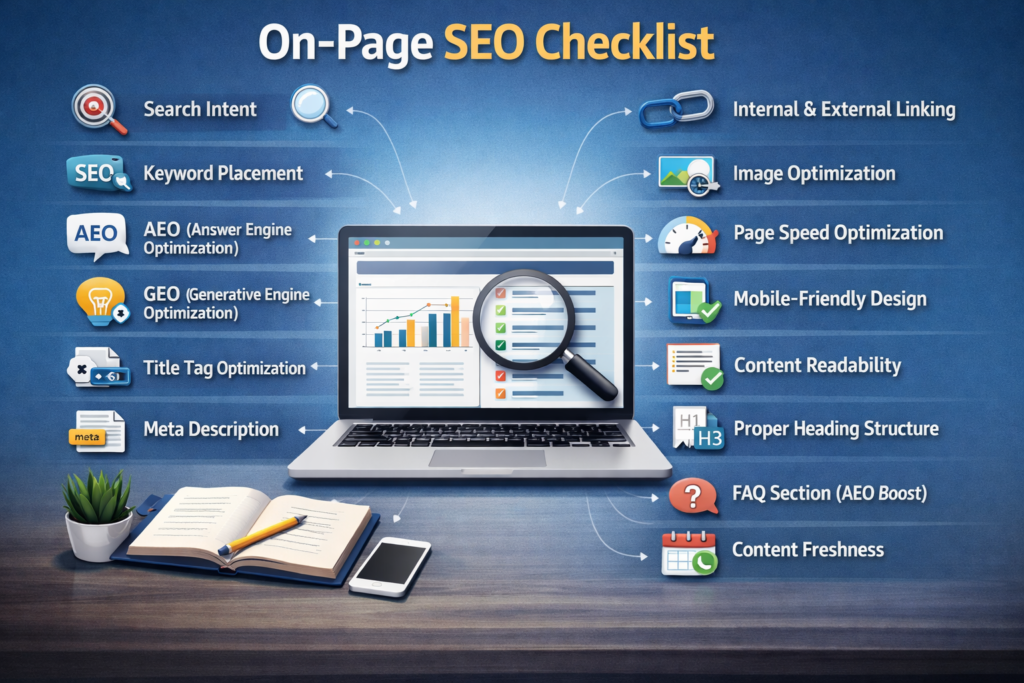
- On-Page SEO Checklist for 2026
- What is On-Page SEO?
- 1. Start with Search Intent
- 2.Smart Keyword Placement (SEO Base)
- 3. AEO (Answer Engine Optimization)
- 4. GEO (Generative Engine Optimization)
- 5.Title Tag Optimization
- 6.Meta Description
- 7.Internal & External Linking
- 8. Image Optimization
- 9. Page Speed Optimization
- 10. Mobile-Friendly Design
- 11. Content Readability (Very Important)
- 12. Proper Heading Structure
- 13. FAQ Section (AEO Boost)
- 14. Content Freshness
- What is On-Page SEO?
What is On-Page SEO?
On-page SEO is the process of optimizing everything inside your webpage so that both Google and users can easily understand your content. It helps your website communicate clearly with search engines while also giving a smooth experience to visitors.
When your page is properly optimized, it becomes easier for Google to identify your topic and show your content to the right audience. At the same time, users can quickly find what they are looking for without confusion.
A well-optimized page helps in:
- Making your content clear and understandable for Google
- Providing quick and useful information to users
- Increasing your chances of ranking higher in search results
Now that you understand what on-page SEO is, let’s break it into simple parts. In this checklist, you’ll learn all the key elements needed to optimize a webpage effectively.
1. Start with Search Intent
Before writing any blog, it is very important to understand what the user actually wants to find. If your content does not match the user’s intent, it will not rank on Google, no matter how well you write it. In most cases, search intent can be divided into two types — informational keyword (when users want to learn something) and transactional keyword (when users want to take action like buying or signing up). So, always create your content based on what the user is searching for to get better results.
2.Smart Keyword Placement (SEO Base)
Keywords are still an important part of SEO, but in 2026, using them naturally is more important than repeating them again and again. Instead of stuffing keywords, you should place them in the right areas of your content so that it feels smooth and readable. Proper keyword placement helps Google understand your topic clearly while keeping the user experience clean and simple.
- Use your keyword in important places like title, first paragraph, URL, headings, and image ALT text
- Always keep the usage natural and avoid overusing the same keyword
3. AEO (Answer Engine Optimization)
Google now prefers content that provides quick and clear answers, which is why AEO is becoming very important in 2026. Instead of long explanations, your content should directly solve the user’s query in a simple and structured way. This makes it easier for search engines and AI tools to understand and pick your content.
- Write short answers, use question-based headings, and include an FAQ section
- This increases your chances of appearing in featured snippets, voice search, and AI-generated results
4. GEO (Generative Engine Optimization)
With the growth of AI tools, your content should be easy for both humans and AI to understand. This is where GEO becomes important. You should focus on writing in simple language, maintaining a clear structure, using small paragraphs, and adding real-life examples. This makes your content more readable, engaging, and easier for AI systems to interpret and present.
5.Title Tag Optimization
Your title is the first thing users see on search results, so it should be clear, attractive, and easy to understand. A well-written title not only tells users what your content is about but also encourages them to click on your link. That’s why it’s important to keep your title short, include your main keyword, and make it engaging.
- Keep your title under 60 characters and include your main keyword
- Make it simple, clear, and clickable to improve your click-through rate
6.Meta Description
A meta description is a short summary shown in search results that helps users decide whether to click your link. It should be clear, engaging, and include your keyword naturally.
Bad: This blog is about SEO.
Good: Learn the complete On-Page SEO Checklist for 2026 with simple and practical tips
7.Internal & External Linking
Internal and external linking both are important for improving SEO and user experience. Internal linking helps users explore your website, while external linking builds trust and credibility.
- Internal linking connects your own blog pages, improves navigation, and keeps users on your site longer
- External linking points to trusted websites like research articles or industry blogs, which increases credibility
- Using both types together helps search engines understand your content better and improves overall SEO
8. Image Optimization
Image optimization is important for on-page SEO as it improves both page speed and user experience. Image optimization includes adding descriptive ALT text with relevant keywords so search engines can understand the image content.
It also involves compressing image size to reduce file weight without losing quality, which helps in faster loading. Additionally, using relevant file names and proper image formats improves performance and SEO.
9. Page Speed Optimization
Page speed optimization is important in on-page SEO because a slow website increases bounce rate and lowers rankings. To reduce page load time, you can compress and optimize images, use a reliable hosting service for better performance, and enable caching to load pages faster for returning users. These simple steps help improve website speed, user experience, and overall SEO performance.
10. Mobile-Friendly Design
Mobile-friendly design is an important factor in on-page SEO because most users browse websites using mobile devices. A responsive and well-optimized blog ensures a better user experience, faster interaction, and improved search engine rankings.
- Ensure text readability by using proper font size and spacing so users don’t need to zoom.
- Use proper button sizes and maintain good mobile loading speed for easy navigation and better performance.
11. Content Readability (Very Important)
Content readability is important because if users find your content hard to read, they may leave quickly. Write in a simple and clear way using short sentences and small paragraphs. Always explain in a beginner-friendly manner so users can easily understand your content, which improves engagement and SEO performance.
12. Proper Heading Structure
Proper heading structure is important in on-page SEO as it helps both users and search engines understand the content easily. A well-organized blog improves readability and makes the page more structured and user-friendly.
Use H1 for the main title of your blog, H2 for major sections, and H3 for sub-points under each section. This hierarchy helps search engines identify the importance of different parts of your content and improves indexing.
13. FAQ Section (AEO Boost)
Adding an FAQ section is a smart way to improve on-page SEO and also boost Answer Engine Optimization (AEO). FAQs help you answer common user questions directly, making your content more useful and informative.
By including relevant questions like what on-page SEO is, why it is important, and whether it still works in 2026, you can target user intent more effectively. This also increases the chances of your content appearing in featured snippets and voice search results, improving visibility and engagement.
14. Content Freshness
Content freshness is important because SEO is not a one-time process, and search engines prefer updated and relevant information. Regularly updating your blog keeps it accurate, useful, and competitive in search rankings.
- Add new and updated information to keep content relevant
- Update old examples and data to match current trends
- Improve and refine existing sections for better clarity and value
By following this On-Page SEO checklist, you can create well-optimized, user-friendly, and high-ranking blog content that performs better in search engines and delivers a great experience to your readers.