
In 2026, Google ranking is no longer based only on keywords, but on user intent, content quality, and overall user experience. To rank for competitive queries like “How to Get First Rank on Google in 2026”, your content must clearly answer user questions, provide depth, and demonstrate real expertise. This also opens opportunities for internal linking to related topics like keyword research, on-page SEO, and technical SEO, helping build topical authority. With the rise of AI-powered search and generative engines, well-structured and context-rich content is more likely to be selected for AI-generated answers, making AEO important. At the same time, factors like page speed, mobile responsiveness, readability, and engagement play a key role in rankings. Overall, modern SEO requires a balance of content quality, technical optimization, and strategic linking.
- How Google Algorithm Works in 2026
- Understanding Search Intent Optimization
- Smart Keyword Research Techniques
- How to Write SEO Friendly Content
- On Page SEO Techniques
- Off Page SEO Strategies & Authority Building
- Technical SEO Checklist for Better Ranking
- How to Get Organic Traffic from Google
- SEO Best Practices 2026 + Fast Ranking Tips
How Google Algorithm Works in 2026
If you want to understand how Google algorithm works in 2026, think of it less like a machine that scans keywords and more like a smart system that tries to understand people. Google’s main goal now is simple — show users the most helpful and relevant content for their query. So if you are targeting a keyword like “How to rank on Google first page in 2026,” your content must actually solve the user’s problem, not just repeat the keyword multiple times.
Today, Google uses advanced AI and machine learning to understand both content and user behavior. It looks at how people interact with your page — do they stay and read, or leave quickly? Do they find answers or go back to search again? These signals help Google decide whether your content is useful or not. That’s why creating engaging, easy-to-read, and valuable content is more important than ever.
Another important part is intent matching. Google tries to figure out what the user really wants behind a search. For example, if someone searches for a guide, they expect detailed information, not a sales pitch. This is where search intent optimization becomes crucial, because if your content matches the user’s expectation, your chances of ranking increase naturally.
When it comes to content evaluation, Google now focuses on quality, clarity, and trust. It checks whether your content is well-structured, informative, and actually helpful. These are all part of modern google ranking factors 2026, where things like content depth, internal linking, page experience, and authority matter a lot more than just keywords.
Understanding Search Intent Optimization
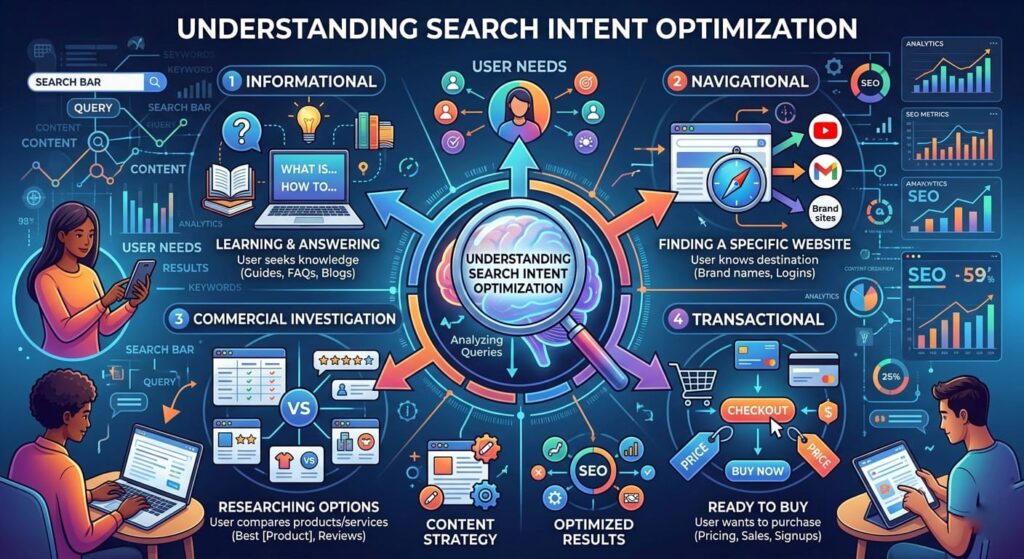
Mastering search intent optimization is one of the most important steps. Google now focuses on showing results that match what users actually want, not just what they type. So when you target a keyword like “How to rank on Google first page in 2026,” your content must directly solve the user’s problem and match their expectation from the search.
Search intent is mainly divided into a few core types, and each one impacts how you should create content:
- Informational Intent: Users want to learn something. Here, you should create detailed guides, tutorials, and explanations that clearly answer their questions.
- Navigational Intent: Users are looking for a specific website or brand, so your content should be clear and direct if you are targeting branded searches.
- Commercial Intent: Users are comparing options before making a decision, so content like comparisons, reviews, and “best of” guides works well.
- Transactional Intent: Users are ready to take action, so your content should be focused on conversion, offers, or services.
Your content strategy should always align with these intent types. For example, if the intent is informational, adding sales-heavy content will not work. Instead, you should focus on clarity, depth, and value. When your content matches intent correctly, users stay longer on your page, engage more, and this sends positive signals to Google.
From an AEO (Answer Engine Optimization) perspective, intent optimization means giving direct answers quickly. Your content should clearly respond to user queries in simple language, especially in the beginning sections. This increases your chances of appearing in featured snippets and AI-generated answers.
From a GEO (Generative Engine Optimization) perspective, your content should go beyond basic answers and provide full context. Adding explanations, examples, and related information helps AI systems understand your content better and use it as a trusted source.
Smart Keyword Research Techniques
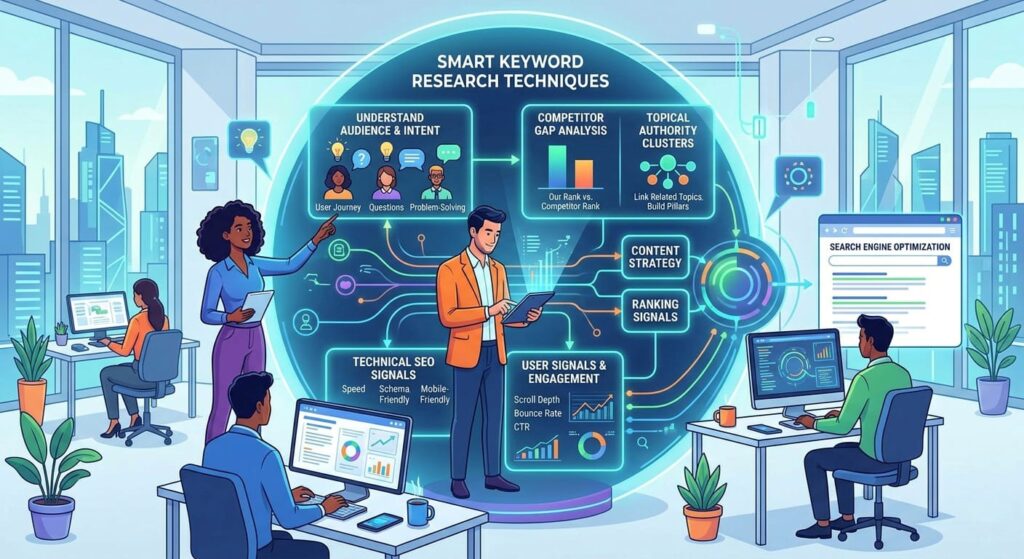
you need more than basic keyword research. Modern SEO focuses on finding the right keywords that match user intent and can be used naturally inside your content. When targeting a main keyword like “How to rank on Google first page in 2026,” you should build your strategy using related secondary keywords such as google search ranking tips and website ranking strategies to strengthen overall relevance.
One of the most important techniques is using long-tail keywords. These are specific search phrases that help you target users with clear intent. For example, keywords like how to get organic traffic from google or improve google ranking fast help attract users who are actively looking for solutions. These keywords are easier to rank for and bring more qualified traffic to your website. Long-tail keywords also reduce competition and increase conversion chances because they match exact user queries.
Another powerful method is using LSI (related semantic keywords). These help Google understand the full context of your content. For example, terms like google ranking factors 2026, seo best practices 2026, and search intent optimization act as supporting signals that improve your content relevance. When used naturally, they help your page rank for multiple search queries at the same time. LSI keywords also help avoid keyword stuffing while improving semantic SEO strength.
You should also focus on intent-based keywords, which are directly connected to what users are searching for. Keywords like how to write seo friendly content, on page seo techniques, and technical seo checklist help structure your content properly and match user expectations. These keywords also improve content depth and make your page more useful for both users and search engines. Intent-based keywords also help Google categorize your page correctly in search results.
- Pro tip: Always place your main keyword in important areas like the title, introduction, and conclusion, while using secondary keywords like keyword research techniques and PPC best practices 2026 naturally throughout the content. Also make sure to use them in headings, subheadings, and internal linking anchor texts for better SEO structure.
- Another important point is keyword mapping. You should assign one primary keyword per page and support it with multiple secondary keywords. This helps avoid keyword cannibalization and improves ranking clarity for Google.
- Also focus on competitor keyword analysis, where you study top-ranking pages and identify what keywords they are using. This helps you discover content gaps and improve your own SEO strategy.
How to Write SEO Friendly Content
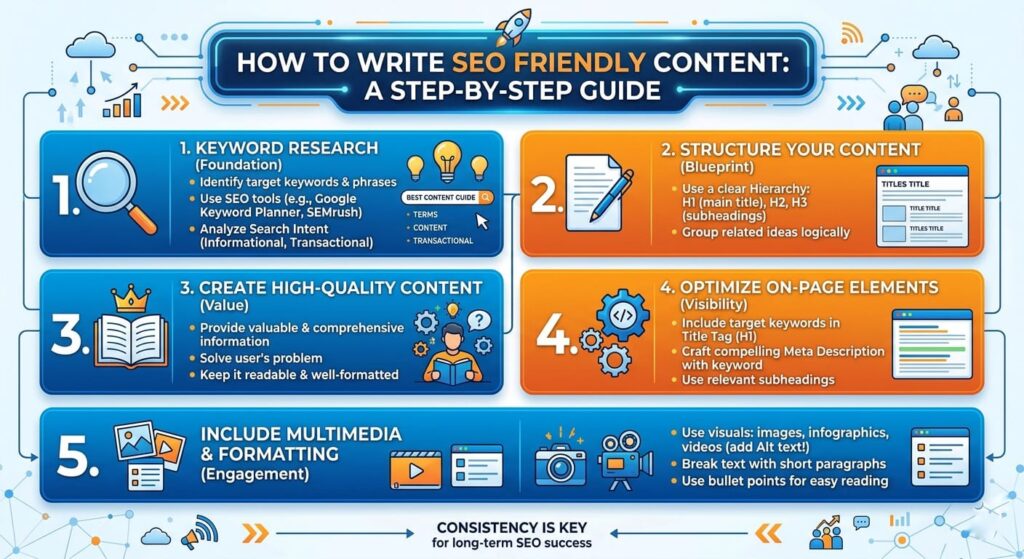
Knowing how to write SEO friendly content is not optional—it is the foundation of your entire SEO strategy. Google no longer ranks content just because it has keywords; it ranks content that is clear, helpful, well-structured, and directly answers user intent. So when you target a keyword like “How to rank on Google first page in 2026,” your content must feel natural, informative, and valuable from the first line itself.
A strong SEO-friendly article always starts with a clear structure. Your content should be divided into proper headings and subheadings so both users and search engines can easily understand it. A well-organized structure improves readability and also helps Google crawl your content more efficiently. When your content flows logically, it becomes easier for AI systems to extract key information from it, which is very important for both SEO and AEO.
Readability is another major factor. Your content should be simple, conversational, and easy to understand. Short paragraphs, natural language, and clear explanations improve user experience. When users stay longer on your page and engage with your content, it sends a strong positive signal to Google that your page is useful and relevant.
Keyword placement is also important, but it should always feel natural. Your main keyword should appear in the title, introduction, and conclusion, while secondary keywords should be distributed naturally throughout the content. Keywords like on page seo techniques, seo best practices 2026, and search intent optimization should be used in context, not forced into sentences. This helps you avoid keyword stuffing while still improving relevance.
Content depth plays a big role in ranking. Google prefers content that fully explains a topic rather than surface-level information. When writing SEO-friendly content, always try to cover the topic from multiple angles so users don’t need to search again. This improves dwell time and increases your chances of ranking higher.
From an AEO (Answer Engine Optimization) perspective, your content should give direct and clear answers. AI systems and featured snippets prefer content that quickly explains concepts in a simple way. So always try to answer the main question early and clearly in your content.
From a GEO (Generative Engine Optimization) perspective, your content should be context-rich and meaningful. This means adding explanations, examples, and supporting details so AI systems can understand the full context of your topic and use your content in generated responses.
On Page SEO Techniques
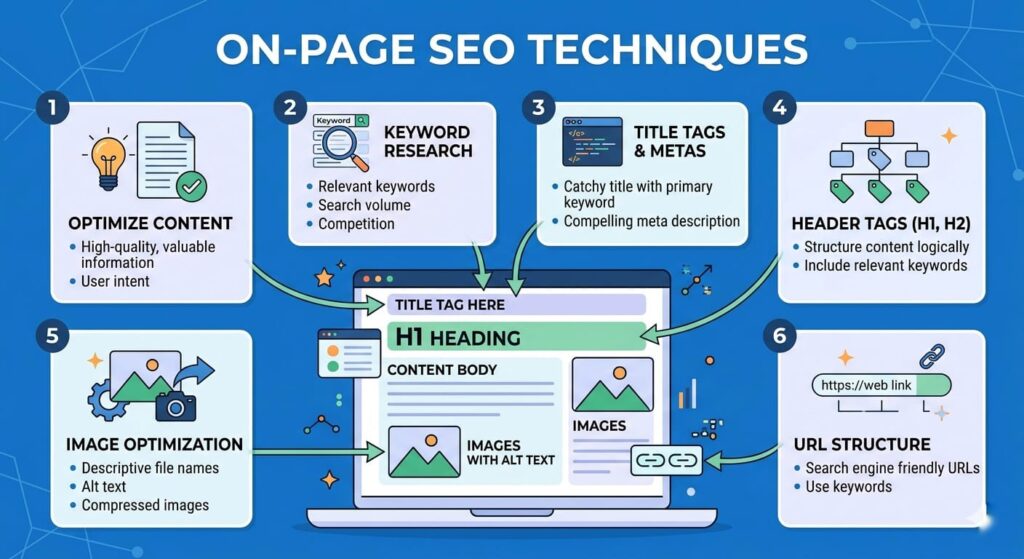
1. Title Optimization
Your title is the first thing users and Google notice, so it must be both attractive and keyword-focused. A well-optimized title should clearly include your main keyword and also make users want to click. In 2026, Google also analyzes click behavior, so a strong title indirectly improves ranking performance.
For example, instead of writing a generic title, you should naturally include your keyword like “How to rank on Google first page in 2026” while keeping it readable and meaningful. A good title is not just about keywords—it is about creating curiosity and clarity at the same time.
2. Meta Description
Meta description does not directly increase ranking, but it plays a huge role in improving click-through rate (CTR). A strong meta description should briefly explain what the page is about and why users should read it.
In modern SEO, your meta description should naturally include secondary keywords like google search ranking tips, seo best practices 2026, or improve google ranking fast. This helps Google understand your page context better and also encourages users to click on your result instead of others.
A well-written meta description acts like a small advertisement for your blog post, so it should always be clear, engaging, and relevant to user intent.
3. Heading Structure (H1, H2, H3)
Heading structure is very important for both readability and SEO. Google uses headings to understand the structure and hierarchy of your content. A properly organized page helps search engines quickly identify what your content is about.
Your H1 should contain the main keyword, while H2 and H3 headings should break the topic into smaller, meaningful sections. This not only improves SEO but also makes your content easier to read for users.
For example, topics like on page seo techniques, search intent optimization, and technical seo checklist should be clearly separated into headings so users can easily navigate through your content.
4. Internal Linking
Internal linking is one of the most powerful but often ignored on-page SEO strategies. It helps connect different pages of your website and improves overall site structure. When you use internal links properly, you help Google understand the relationship between your blog posts.
For example, if you are writing about on-page SEO, you can link to related articles like keyword research techniques, how to write seo friendly content, or website ranking strategies. This not only improves SEO but also keeps users longer on your website, which increases engagement signals.
Off Page SEO Strategies & Authority Building
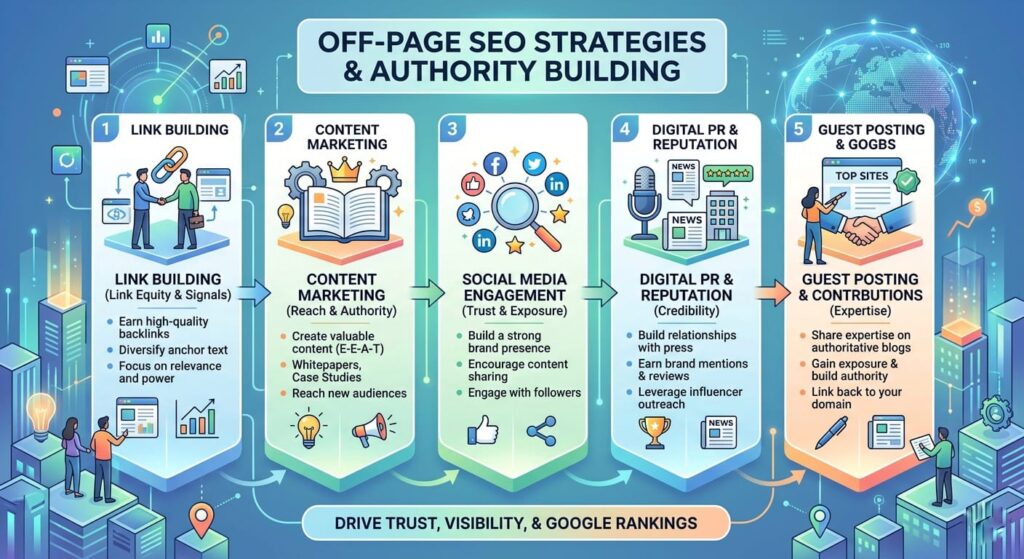
you cannot depend only on on-page SEO. You also need strong off page SEO strategies that help Google understand your website’s authority, trust, and popularity across the internet. Even if your content is high quality, without authority building, it becomes difficult to compete for keywords like “How to rank on Google first page in 2026.” Off-page SEO mainly focuses on how other websites and platforms perceive your content.
1. Backlink Building (Quality Over Quantity)
Backlinks are still one of the strongest ranking signals in 2026, but the approach has changed. Now Google values quality, relevance, and trust more than the number of links. A single backlink from a high-authority website is more powerful than multiple low-quality links.
To build strong backlinks, you should focus on guest posting, niche relevant websites, and creating content that people naturally want to reference. Keywords like seo best practices 2026 and website ranking strategies often perform better when supported by strong backlink profiles.
2. Brand Mentions & Online Presence
In modern SEO, even unlinked brand mentions can help improve authority. When your website or brand is mentioned across blogs, forums, or social platforms, Google starts recognizing it as a trusted entity. Building a strong online presence through consistent content, social sharing, and engagement increases your brand visibility. This helps improve trust signals, which are now an important part of google ranking factors 2026.
3. Social Signals & Content Distribution
Although social media links are not direct ranking factors, they play an important indirect role. When your content gets shared widely on platforms like LinkedIn, Twitter, or Facebook, it increases traffic and visibility. More visibility means more chances of earning backlinks naturally. This also improves engagement signals, which support your overall SEO performance and help in improve google ranking fast strategies.
4. Guest Posting & Authority Building
Guest posting is still one of the most effective ways to build authority in your niche. By publishing content on relevant and trusted websites, you not only get backlinks but also build credibility in your industry. When you write guest posts, always focus on valuable content rather than just link placement. This helps you establish authority in topics like on page seo techniques, keyword research techniques, and other SEO-related areas.
5. Building Topical Authority
Topical authority means becoming a trusted source in a specific niche. Instead of writing random topics, you should focus on creating content clusters around SEO, PPC, SMM, and digital marketing. When Google sees that your website consistently covers related topics in depth, it increases your chances of ranking higher for multiple keywords. This is very important for long-term growth and aligns strongly with seo best practices 2026.
Technical SEO Checklist for Better Ranking
1. Page Speed Optimization
Page speed is one of the most important ranking factors in 2026. If your website takes too long to load, users will leave before even reading your content, which increases bounce rate and negatively affects rankings. Google considers fast-loading pages as more user-friendly, so speed directly impacts your visibility.
To improve page speed, you should compress images, use lightweight themes, enable caching, and reduce unnecessary scripts. A faster website not only improves rankings but also enhances user experience, which supports your overall google search ranking tips strategy.
2. Mobile Optimization
Most users now browse Google from mobile devices, so mobile optimization is no longer optional—it is essential. Google uses mobile-first indexing, which means it primarily evaluates your mobile version for ranking purposes.
Your website should be responsive, easy to navigate, and readable on all screen sizes. Buttons should be clickable, text should be clear, and layout should not break on mobile. A fully optimized mobile experience helps improve engagement and supports better performance in google ranking factors 2026.
3. Core Web Vitals
Core Web Vitals are a set of performance metrics that measure user experience on your website. These include loading speed, interactivity, and visual stability. In simple terms, Google checks how fast your page loads, how quickly users can interact with it, and whether the layout shifts while loading. Improving Core Web Vitals helps your website feel smoother and more stable for users. This leads to better engagement and lower bounce rates, which indirectly improves your chances of ranking higher on Google.
4. Indexing & Crawlability
Indexing is the process where Google adds your pages to its search database. If your pages are not indexed properly, they will not appear in search results, no matter how good your content is. That’s why proper indexing is a critical part of technical SEO. You should ensure that your sitemap is submitted to Google Search Console, your robots.txt file is properly configured, and there are no broken links or crawl errors. This helps Google easily discover and understand your content, improving your overall visibility
How to Get Organic Traffic from Google
- Create High-Quality, Search Intent Based Content
2. Target the Right Keywords
3.Focus on On Page SEO Optimization
4.Improve Content Depth and Value
5.Build Internal Linking Structure
6.Use SEO Best Practices Consistently
SEO Best Practices 2026 + Fast Ranking Tips
If you want to rank quickly on Google in 2026, you need to follow updated seo best practices 2026 along with smart optimization techniques. Google now focuses on user intent, content quality, and website experience, so your strategy must be clean, consistent, and value-driven. For competitive keywords like “How to rank on Google first page in 2026,” these practices can help you build both long-term and fast results.
1.Focus on Search Intent First
2.Use Smart Keyword Strategy
3.Create High-Quality Content
4.Optimize On Page SEO Properly
5.Improve Technical SEO
6.Build Strong Internal Linking
7.Build Authority with Off Page SEO
8.Update Content Regularly
Ranking on Google’s first page in 2026 requires a complete SEO approach, including search intent optimization, on-page SEO techniques, technical SEO, and off-page strategies. When you follow seo best practices 2026 and create valuable, user-focused content, your chances of ranking increase naturally.
SEO is no longer about shortcuts—it’s about consistency, quality, and understanding how Google algorithm works. If you apply the right strategies step by step, you can improve rankings and get consistent organic traffic.
Pingback: On-Page SEO Checklist for 2026
Pingback: Top 10 Best Digital Marketers in India (2026)