
How Does Pay Per Click Work?
Pay Per Click (PPC) is an online advertising model where advertisers pay a fee each time someone clicks on their ad. Instead of earning traffic organically, businesses can buy visits to their website through paid ads.
For example, when you search on Google for something like “best SEO course in India,” you will notice some results marked as “Sponsored.” These are PPC ads. Businesses bid on keywords, and when users click on their ads, they are charged a small amount. This makes PPC a highly effective strategy for businesses that want immediate visibility and targeted traffic.
How Does Pay Per Click Work? (Step-by-Step Explanation)
To fully understand how to do PPC marketing, you need to know how the system works behind the scenes. PPC operates through a structured process that involves keyword targeting, ad creation, and an auction system.
Step 1: Keyword Selection
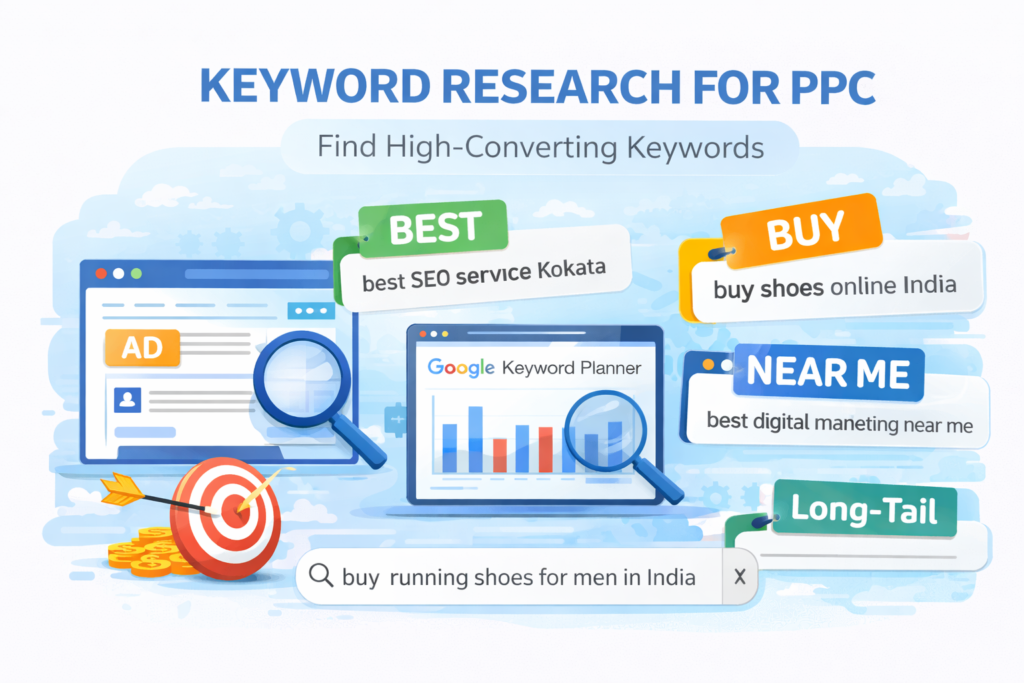
The first step in PPC marketing is choosing the right keywords. These are the search terms your target audience uses on platforms like Google. that helps also your SEO ranking. Advertisers usually focus on high-intent keywords such as “buy,” “best,” or “near me” because they indicate that the user is ready to take action. Proper keyword research ensures that your ads appear in front of the right audience.
Step 2: Ad Creation
Once keywords are selected, the next step is to create compelling ads. A good PPC ad includes an attention-grabbing headline, a clear description, and a strong call-to-action (CTA) like “Buy Now,” “Learn More,” or “Get Started.” The goal is to attract users and convince them to click on your ad instead of competitors.
Step 3: Auction System
Every time a user searches for something, platforms like Google Ads run an instant auction to decide which ads will appear. Advertisers bid on keywords, but the highest bidder does not always win. Google also considers the quality of the ad, relevance, and expected click-through rate. This ensures that users see useful and relevant ads instead of just the highest-paying ones.
Step 4: Ad Ranking
After the auction, Google ranks ads based on a combination of bid amount and Quality Score. Quality Score depends on factors like ad relevance, landing page experience, and expected CTR. Even with a lower bid, a high-quality ad can rank higher than competitors. This makes optimization very important in PPC campaigns.
Step 5: Click & Payment
Finally, when a user clicks on your ad, you pay a small fee known as Cost Per Click (CPC). If no one clicks on your ad, you don’t pay anything. This makes PPC a cost-effective strategy because you are only paying for actual engagement, not just impressions.
| Step | Process | Explanation |
|---|---|---|
| 1 | Keyword Selection | Choosing search terms your audience uses |
| 2 | Ad Creation | Writing engaging and relevant ads |
| 3 | Auction | Advertisers compete in real-time |
| 4 | Ranking | Ads ranked based on bid + quality |
| 5 | Click & Payment | You pay only when someone clicks |
What is CPC (Cost Per Click)
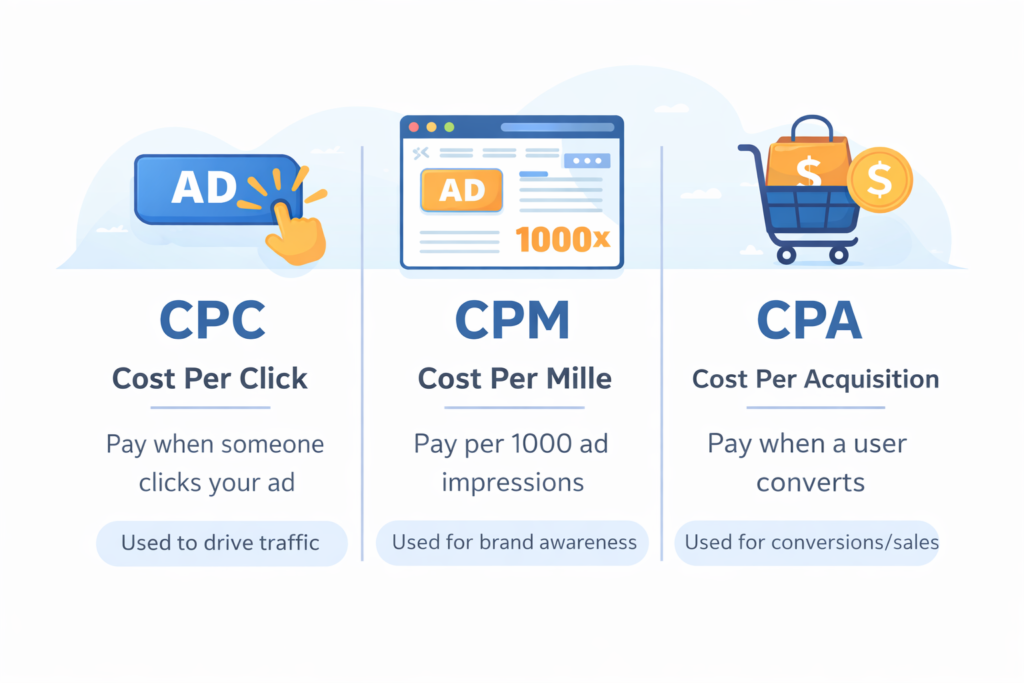
CPC is a pricing model where you pay only when someone clicks on your ad. It is mainly used to drive traffic to your website and is very common in search advertising. This model is effective when your goal is to get visitors, but you need to optimize campaigns to turn clicks into conversions.
What is CPM (Cost Per impression)
CPM means you pay for every 1000 impressions (views) of your ad, regardless of clicks. It is mostly used for brand awareness campaigns where the goal is to reach a large audience. This model helps increase visibility but does not guarantee engagement or conversions.
What is CPA (Cost Per Acquisition)
CPA is a model where you pay only when a user completes a specific action, such as a purchase or signup. It is highly result-oriented and ideal for businesses focused on conversions. Although it provides better ROI tracking, it may require strong optimization to keep costs low.
| Factor | CPC (Cost Per Click) | CPM (Cost Per 1000 Impressions) | CPA (Cost Per Acquisition) |
|---|---|---|---|
| Meaning | You pay for each click on your ad | You pay for 1000 ad impressions (views) | You pay when a specific action is completed |
| Main Goal | Drive traffic to website | Increase brand awareness | Generate conversions (sales/leads) |
| When You Pay | When user clicks the ad | When ad is shown 1000 times | When user completes action (purchase/signup) |
| Best For | Website traffic, blog visits | Branding campaigns | Sales, lead generation |
| Risk Level | Medium (click ase but conversion nao hote pare) | High (views ase, click nao hote pare) | Low (only pay for result) |
| Cost Control | Easy to control with bid strategy | Hard (no guarantee of engagement) | Controlled but sometimes higher cost |
| ROI Measurement | Moderate | Difficult | Very easy & accurate |
| Example | ₹10 per click | ₹200 per 1000 views | ₹300 per sale |
| Platform Use | Google Ads, Search Ads | Display Ads, YouTube Ads | Conversion-focused campaigns |
| Focus Area | Click-through rate (CTR) | Impressions & reach | Conversion rate |
Why Choosing the Right PPC Platform is Important?
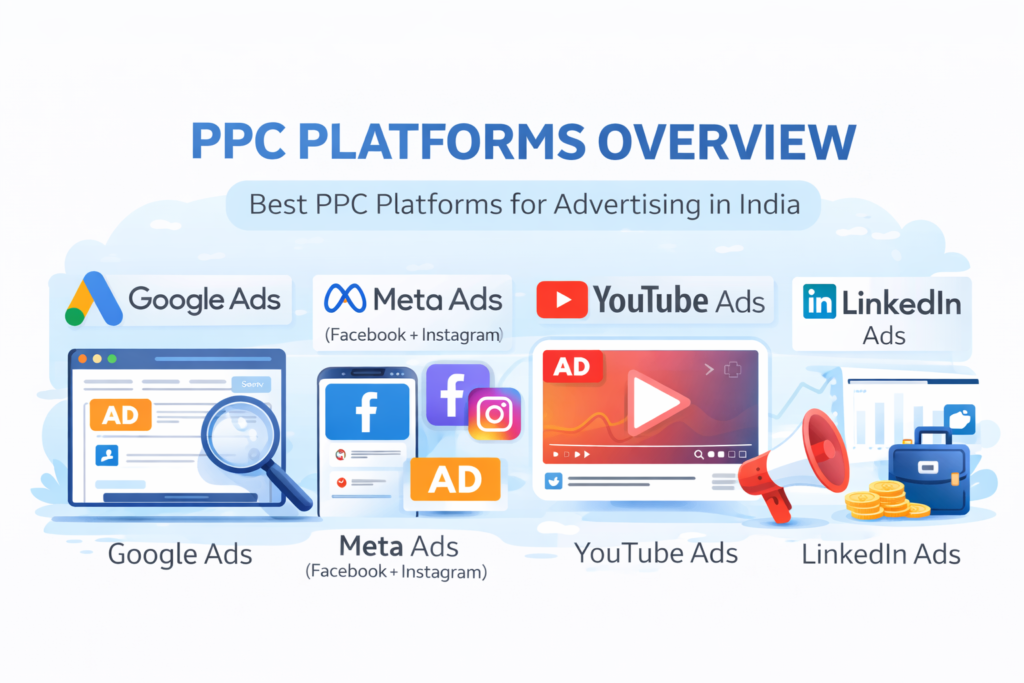
Selecting the right platform is one of the most important steps in how to do PPC marketing effectively. Every platform has a different type of audience, intent level, and advertising format. For example, users on Google are actively searching for something, while users on social media platforms are more engaged in browsing and discovering content.
If you choose the wrong platform, you may end up wasting your budget without getting good results. On the other hand, the right platform can help you reach your target audience faster and improve your ROI significantly.
Google Ads (Most Popular in India)
Google Ads is the most widely used PPC platform, especially in India. It allows businesses to show ads on Google search results, websites, and apps. Since users are actively searching for solutions, Google Ads has very high buying intent.
For example, if someone searches for “best SEO services in Kolkata,” your ad can appear at the top. This makes Google Ads perfect for businesses that want leads, sales, or website traffic quickly. It works best for service-based businesses, local businesses, and eCommerce stores.
Best For:
- Local businesses (India/Kolkata targeting)
- Service-based businesses
- High-intent keywords
Meta Ads (Facebook + Instagram)
Meta Ads include advertising on Facebook and Instagram. Unlike Google Ads, users here are not actively searching, but you can target them based on interests, behavior, and demographics. This makes it very powerful for brand awareness and engagement.
For example, if you are running a fashion brand, you can show ads to people interested in clothing, shopping, or lifestyle content. Meta Ads are also highly visual, which makes them ideal for storytelling and creative marketing.
Best For:
- Brand awareness
- Engagement & followers
- E-commerce & lifestyle brands
YouTube Ads (Video Marketing Power)
YouTube Ads are a part of Google Ads and are focused on video marketing. Since video content is highly engaging, YouTube ads can help you explain your product or service more effectively than text or images.
For example, if you are promoting an online course, you can create a short video explaining its benefits and run it as an ad. In India, YouTube has a massive audience, making it a great platform for both awareness and conversions.
Best For:
- Video marketing
- Product demos
- Brand storytelling
LinkedIn Ads (Best for B2B Marketing)
LinkedIn Ads are mainly used for B2B (business-to-business) marketing. The audience on LinkedIn consists of professionals, business owners, and decision-makers. This makes it ideal for companies targeting other businesses.
For example, if you are offering digital marketing services to companies, LinkedIn Ads can help you reach CEOs, managers, or marketing professionals directly. Although it is more expensive than other platforms, the quality of leads is usually very high.
Best For:
- B2B marketing
- Professional services
- High-value leads
| Platform | Audience Type | Best For | Cost Level |
|---|---|---|---|
| Google Ads | High intent (search users) | Leads & sales | Medium–High |
| Meta Ads | Interest-based audience | Awareness & engagement | Low–Medium |
| YouTube Ads | Video viewers | Branding & education | Medium |
| LinkedIn Ads | Professionals (B2B) | High-quality leads | High |
: Keyword Research for PPC
- High intent keyword
- Commercial vs informational keywords
- Tools: Google Keyword Planner
- Long-tail keywords importance
Why Keyword Research is Important in PPC?
Keyword research helps you target the right audience at the right time. In PPC, you are paying for every click, so choosing the wrong keywords can waste your budget quickly. On the other hand, the right keywords can bring highly targeted users who are ready to take action.
For example, someone searching “digital marketing” is just exploring, but someone searching “buy digital marketing course online India” is ready to purchase. This is why understanding keyword intent is extremely important in PPC marketing effectively.
What are High-Intent Keywords?
High-intent keywords are search terms used by people who are ready to take action, such as buying a product, signing up, or contacting a service provider. These keywords usually include action words that show clear intent.
For example, keywords like “buy shoes online,” “best SMM services in Kolkata,” or “hire PPC expert India” indicate strong intent. These users are not just browsing—they are looking for solutions. Targeting high-intent keywords increases your chances of getting conversions and improves your ROI.
Examples of High-Intent Keywords:
- Buy laptop online India
- Best coaching center in Kolkata
- Hire digital marketing agency
Commercial vs Informational Keywords
Understanding the difference between commercial and informational keywords is very important for PPC campaigns. Both types have different purposes and should be used strategically.
Informational Keywords
Informational keywords are used when users are looking for information or learning something. These keywords usually include words like “how,” “what,” or “guide.” While they bring traffic, they may not always lead to immediate conversions.
Commercial Keywords
Commercial keywords show buying intent. These include words like “best,” “top,” “buy,” or “price.” Users searching with these keywords are closer to making a decision, which makes them more valuable for PPC campaigns.Comparison Table:
| Type | Purpose | Example | Conversion Chance |
|---|---|---|---|
| Informational | Learning | how to do PPC marketing | Low |
| Commercial | Buying intent | best PPC course India | High |
Keyword Research Tools (Google Keyword Planner)
One of the most popular tools for PPC keyword research is Google Keyword Planner. It is free to use and provides valuable data such as search volume, competition level, and estimated cost per click.
Using this tool, you can discover new keyword ideas, analyze competition, and select keywords that match your budget and goals. It is especially useful for beginners who are learning how to do PPC marketing, as it gives reliable data directly from Google.
What You Can Do with Keyword Planner:
- Find new keyword ideas
- Check search volume
- Analyze competition
- Estimate CPC
Importance of Long-Tail Keywords
Long-tail keywords are longer and more specific search phrases. Although they have lower search volume, they usually have higher conversion rates because they target a more specific audience.
For example, instead of targeting “shoes,” a long-tail keyword would be “buy running shoes for men in India.” This keyword clearly shows what the user wants, making it easier to convert them into customers.
Long-tail keywords are also less competitive, which means lower cost and better ROI in PPC campaigns.
Examples:
- Short keyword: digital marketing
- Long-tail keyword: best digital marketing course in Kolkata
SEO + AEO + GEO Keyword Strategy
To make your PPC campaigns more effective, you should focus on keywords that match user intent, location, and search behavior. In India, especially for local businesses, GEO-targeted keywords perform very well.
Using words like:
- “best” (best SEO service India)
- “buy” (buy shoes online India)
- “near me” (coaching center near me)
These keywords help you target users who are ready to take action. This approach not only improves your PPC performance but also aligns with SEO and AEO strategies.
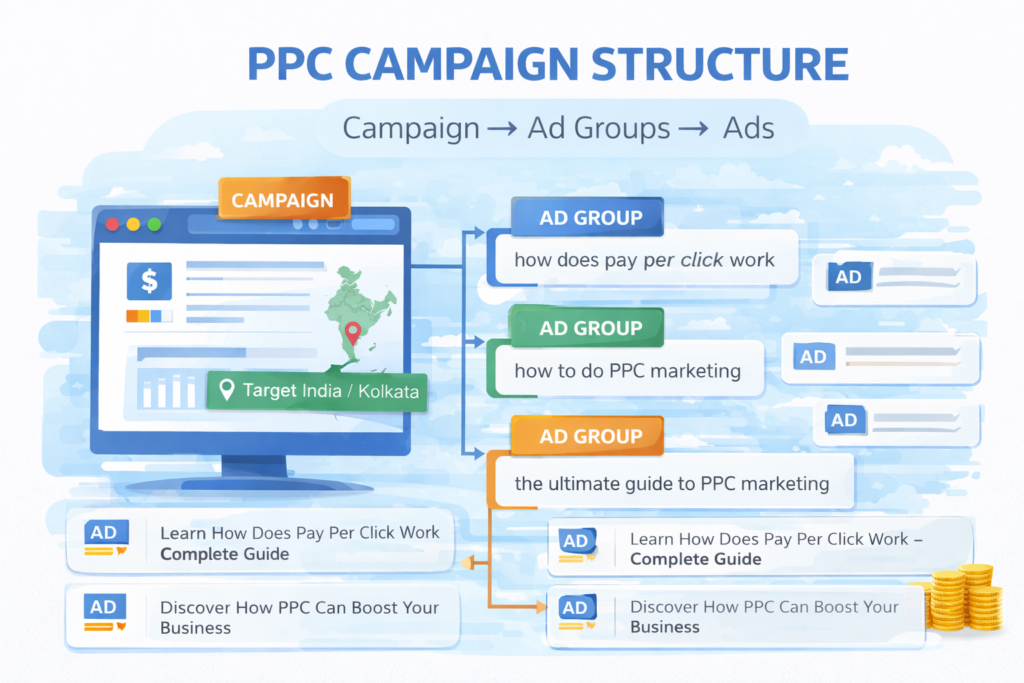
What is PPC Campaign Structure?
PPC campaign structure refers to how your ads are organized inside an advertising platform. A proper structure ensures that your ads are relevant to the keywords and audience you are targeting.
A poorly structured campaign can lead to wasted budget, low-quality traffic, and poor results. On the other hand, a well-structured campaign improves Quality Score, increases click-through rate (CTR), and reduces cost per click (CPC).
Step-by-Step PPC Campaign Setup
| Step | What You Do | Description | Example (Using Your Keywords) |
|---|---|---|---|
| 1. Define Goal | Campaign objective set koro | Decide koro tumi traffic, leads naki sales chao. Clear goal thakle strategy strong hoy | Goal: Promote blog on how does pay per click work |
| 2. Keyword Research | Right keyword choose koro | High-intent + long-tail keyword use koro jate conversion beshi hoy | how does pay per click work, how to do PPC marketing, the ultimate guide to PPC marketing |
| 3. Create Campaign | Campaign setup koro | Platform (Google Ads) e giye campaign create koro with proper settings | Campaign Name: PPC Guide India |
| 4. Set Location (GEO) | Target audience location select koro | India ba specific city (like Kolkata) target korle better result pawa jai | Target: India / Kolkata |
| 5. Create Ad Groups | Keyword wise grouping koro | Same type er keyword gulo ek group e rakho for better relevance | Ad Group 1: how does pay per click work |
| 6. Write Ads | Ad copy likho | Attractive headline + CTA use koro jate click ashe | “Learn How Does Pay Per Click Work – Complete Guide” |
| 7. Set Budget | Daily budget decide koro | Choto budget diye start kore gradually increase koro | ₹200–₹500/day |
| 8. Choose Bidding | Bidding strategy select koro | CPC, CPA ba Max Conversions choose koro goal onujayi | Beginners: CPC |
| 9. Launch Campaign | Campaign live koro | Sob kichu check kore campaign run koro | Launch PPC campaign |
| 10. Monitor & Optimize | Performance track koro | CTR, CPC, conversion check kore optimize koro | Improve keywords + ads |
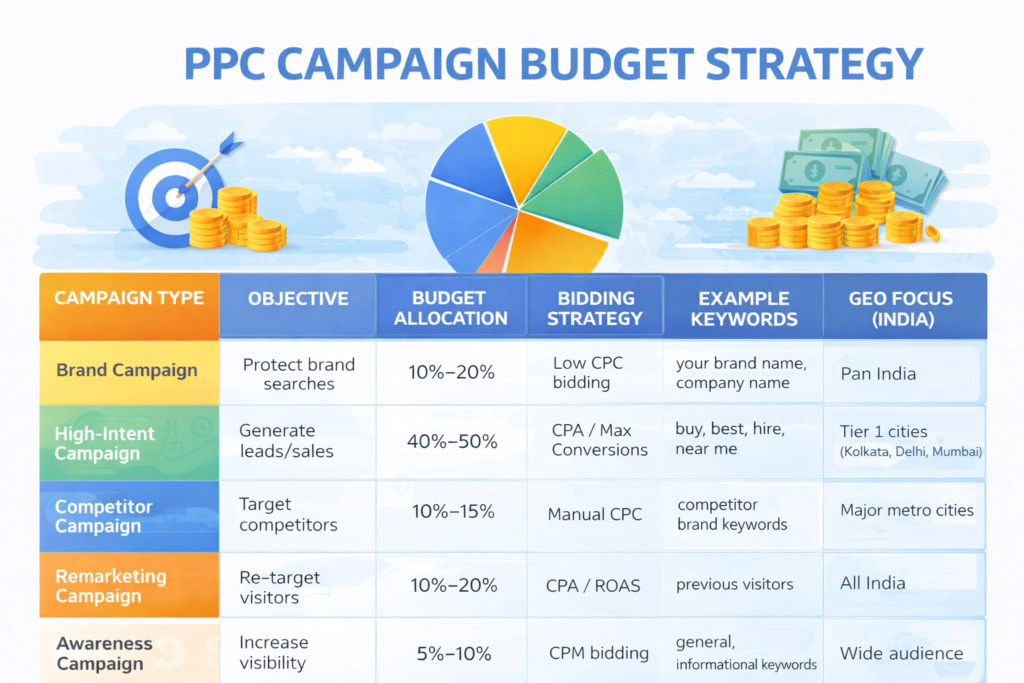
How to control budget in PPC campaigns?
Budget control is a crucial part of how to do PPC marketing successfully. Without proper budget management, you may spend too much without getting good results.
At the campaign level, you can set a daily or monthly budget. This ensures that your spending stays within limits. You should also monitor performance regularly and adjust your budget based on results.
For example, if one ad group is performing well, you can increase its budget. If another is not performing, you can reduce or pause it. This helps you maximize ROI and avoid wasting money.
| Campaign Type | Objective | Budget Allocation | Bidding Strategy | Example Keywords | GEO Focus (India) |
|---|---|---|---|---|---|
| Brand Campaign | Protect brand searches | 10% – 20% | Low CPC bidding | your brand name, company name | Pan India |
| High-Intent Campaign | Generate leads/sales | 40% – 50% | CPA / Max Conversions | buy, best, hire, near me | Tier 1 cities (Kolkata, Delhi, Mumbai) |
| Competitor Campaign | Target competitors | 10% – 15% | Manual CPC | competitor brand keywords | Major metro cities |
| Remarketing Campaign | Re-target visitors | 10% – 20% | CPA / ROAS | previous visitors | All India |
| Awareness Campaign | Increase visibility | 5% – 10% | CPM bidding | general, informational keywords | Wide audience |
A well-structured PPC campaign is the backbone of successful advertising. By organizing your campaigns into proper levels, segmenting your audience, and controlling your budget, you can significantly improve your results. This module is a key part of the ultimate guide to PPC marketing, helping you build strong and effective campaigns.
Why Ad Copy Matters in PPC ?
Your ad copy directly affects click-through rate (CTR) and conversions. Targeting keywords like how does pay per click work, the ultimate guide to PPC marketing, or how to do PPC marketing is only effective if the ad is compelling. High-quality ad copy ensures your campaign reaches the right audience and maximizes ROI
Headline Writing Formula:-
the headline is the first thing users notice. A simple but effective formula can boost clicks:
[Number/Offer] + [Keyword] + [Benefit]
Examples:
- “Learn How Does Pay Per Click Work in 7 Easy Steps”
- “The Ultimate Guide to PPC Marketing – Boost Your Traffic Today”
Use of Power Words:-
Power words evoke emotion and make your ad irresistible. They increase CTR and engagement.
Common Power Words for PPC Ads:
- Free, Instant, Easy
- Proven, Exclusive, Secret
- Best, Ultimate, Guaranteed
Example Ad:
“Get the Ultimate Guide to PPC Marketing – Proven Strategies to Boost Your ROI!”
Call-to-Action (CTA):-
Your CTA tells users what to do next. Strong, action-oriented CTAs improve conversions.
High-Converting CTAs:
- Buy Now
- Get Offer
- Learn More
- Sign Up Today
- Start Free Trial
Example:
“Learn How Does Pay Per Click Work – Sign Up Today!”
Emotional vs Logical Ads:-
Different users respond to different messaging. Balancing emotional and logical appeal can improve performance.
- Emotional Ads: Trigger feelings like fear, excitement, or curiosity.
Example: “Don’t miss out! Boost your website traffic now.” - Logical Ads: Focus on facts, numbers, and practical benefits.
Example: “Increase ROI by 30% with our step-by-step PPC guide.”
How important is keyword placement?
| Element | Best Practice | Example (SEO + GEO) |
|---|---|---|
| Headline | Include keyword + benefit | “Learn How Does Pay Per Click Work in 7 Steps” |
| Power Words | Use 1–2 strong words | Ultimate, Proven, Free |
| CTA | Clear & action-oriented | Buy Now / Sign Up Today |
| Ad Type | Emotional vs Logical | Emotional: Don’t miss out! / Logical: Boost ROI 30% |
| GEO Tip | Include location | “Best PPC Marketing Tips for India-Based Businesses” |
Why Landing Page Optimization Matters ?
A landing page is where your potential customer completes the desired action—whether signing up, buying, or downloading. Ads alone cannot drive conversions; the landing page must deliver a consistent and relevant experience.
In India, where mobile users dominate online traffic, mobile optimization is critical. Fast, clear, and actionable landing pages directly impact your PPC ROI.
Ad → Landing Page Connection
Your ad and landing page must match in message, keywords, and design. If a user clicks on an ad promising a “PPC Marketing Guide,” the landing page must deliver exactly that, not something unrelated.
Tips for Matching Ads and Landing Pages:
- Same headline/keywords as the ad
- Visual consistency (colors, branding)
- Relevant content aligned with the ad offer
Example:
Ad: “Learn How Does Pay Per Click Work – Sign Up Today!”
Landing Page: Step-by-step PPC course signup form + headline “How Does Pay Per Click Work – Complete Guide”
Fast Loading Page (Speed is ROI)
Page load speed is a major factor for conversions. Slow pages increase bounce rate and reduce ROI.
Tips to Improve Speed:
- Compress images (use WebP)
- Minimize JavaScript and CSS
- Use fast hosting & CDN
Benchmark: Landing pages should load in ≤3 seconds for better conversions, especially for mobile users in India.
Mobile Optimization
In India, over 70% of internet traffic comes from mobile devices. A landing page not optimized for mobile will lose the majority of visitors.
Mobile Optimization Tips:
- Responsive design (works on all devices)
- Large CTA buttons for tapping
- Clear content hierarchy
- Avoid pop-ups that cover the screen
Example CTA Placement for Mobile:
- Above the fold for instant visibility
- Repeated at the bottom after content for convenience
what are the elements are more important in landing page ?
| Element | Best Practice | Example (India / GEO Optimized) |
|---|---|---|
| Headline | Match ad keyword | “How Does Pay Per Click Work – Complete Guide” |
| Content | Relevant & concise | Step-by-step PPC marketing instructions |
| CTA | Clear & visible | “Sign Up Today – Free India Trial” |
| Mobile | Fully responsive | Large buttons, simple layout |
| Loading | ≤3 seconds | Compress images, use CDN |
| GEO | Localize content | “Digital Marketing Course for Kolkata Businesses” |
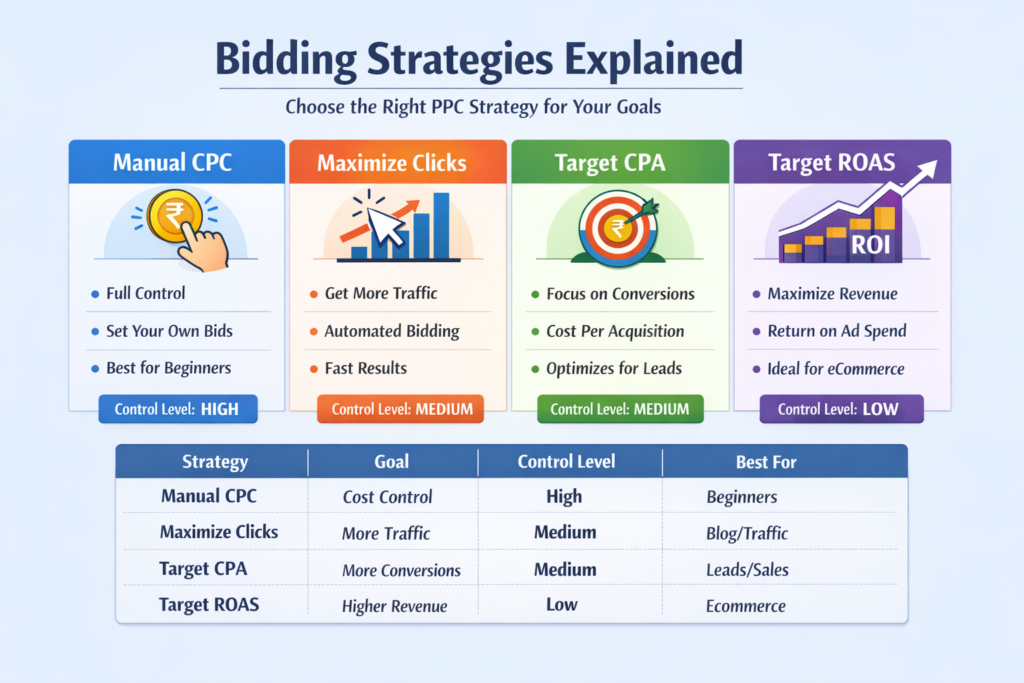
What is a PPC Bidding Strategy?
A PPC bidding strategy is the method you use to decide how much you are willing to pay for clicks, conversions, or impressions. Different strategies are designed for different goals, such as driving traffic, generating leads, or maximizing return on investment.
Choosing the wrong strategy can waste your budget, while the right one can significantly improve your campaign performance and ROI.
Manual CPC (Full Control Strategy)
Manual CPC (Cost Per Click) allows you to set your own bid for each keyword. This gives you complete control over how much you spend on clicks.
This strategy is best for beginners who are learning how to do PPC marketing, as it helps you understand keyword performance and cost behavior. However, it requires regular monitoring and optimization to get the best results.
Best For:
- Beginners
- Small budget campaigns
- Learning phase
Maximize Clicks (Traffic-Focused Strategy)
Maximize Clicks is an automated bidding strategy where Google tries to get as many clicks as possible within your budget.
This is ideal when your goal is to drive traffic to your website quickly. However, since the focus is on clicks rather than conversions, the quality of traffic may vary.
Best For:
- Website traffic
- Blog promotion
- Awareness campaigns
Target CPA (Conversion-Focused Strategy)
Target CPA (Cost Per Acquisition) is a smart bidding strategy where you set the cost you are willing to pay for a conversion, and Google automatically adjusts bids to achieve that goal.
This strategy is highly effective for businesses focused on leads or sales. It uses machine learning to optimize performance, making it a powerful option once you have enough data.
Best For:
- Lead generation
- Sales campaigns
- Conversion optimization
Target ROAS (Revenue-Focused Strategy)
Target ROAS (Return on Ad Spend) focuses on maximizing revenue. You set a target return, and Google adjusts bids to achieve that return.
This is an advanced strategy used mainly by eCommerce businesses. It ensures that your ad spend generates profitable returns, making it ideal for scaling campaigns.
Best For:
- eCommerce
- High-budget campaigns
- Revenue optimization
How to Choose the Right Strategy ?
| Strategy | Goal | Control Level | Best For | Risk Level |
|---|---|---|---|---|
| Manual CPC | Control cost per click | High | Beginners | Medium |
| Maximize Clicks | Increase traffic | Low | Blog/traffic campaigns | Medium–High |
| Target CPA | Get conversions | Medium | Leads & sales | Low |
| Target ROAS | Maximize revenue | Low | eCommerce | Low |
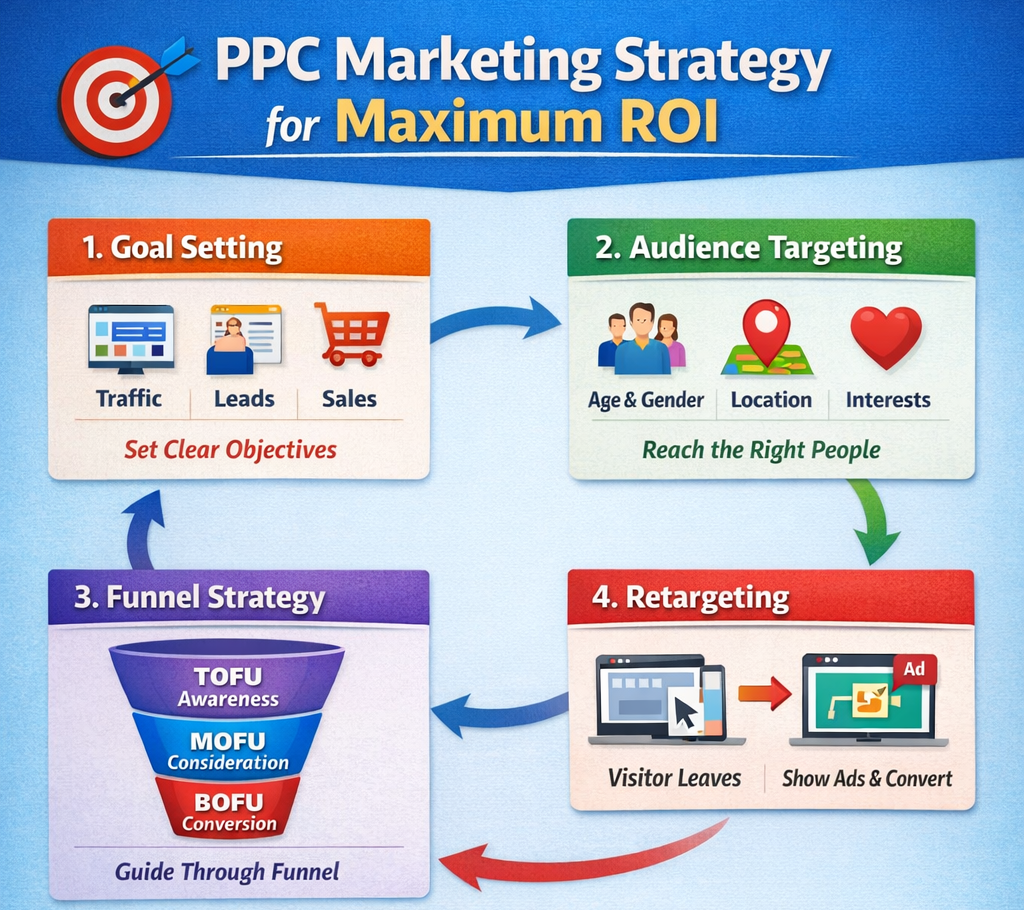
PPC Marketing Strategy
The PPC Strategy Framework :-
Goal → Audience → Funnel → Retargeting → Optimization
How to do PPC marketing effectively?
Step 1: Goal Setting (Foundation of PPC)
Every PPC campaign should start with a clear goal. Without a defined objective, you cannot measure success or optimize performance.
There are mainly three types of goals in PPC marketing:
- Traffic: Bring visitors to your website (blogs, content pages)
- Leads: Generate signups, inquiries, or contacts
- Sales: Drive direct purchases or conversions
For example, if your goal is to rank content like how does pay per click work, you should focus on traffic. But if you are selling a course, your goal should be leads or sales.
Goal Strategy Table:
| Goal Type | Focus | Best Strategy |
|---|---|---|
| Traffic | Website visits | Maximize Clicks |
| Leads | Form submissions | Target CPA |
| Sales | Revenue generation | Target ROAS |
Step 2: Audience Targeting (Reach the Right People)
Audience targeting is one of the most powerful parts of how to do PPC marketing. Instead of showing ads to everyone, you can target specific users based on demographics and behavior.
You can target users based on:
- Age & Gender
- Location (India, Kolkata, etc.)
- Interests & behavior
For example, if you are promoting a digital marketing course, you can target students aged 18–30 who are interested in marketing.
- “Audience targeting dashboard (age, interest, location)”
Step 3: Funnel Strategy (Top → Middle → Bottom)
A strong PPC strategy always follows a marketing funnel. Not all users are ready to buy immediately, so you need to guide them step by step.
Top of Funnel (TOFU – Awareness)
At this stage, users are just learning. Use informational keywords like:
- how does pay per click work
- the ultimate guide to PPC marketing
Middle of Funnel (MOFU – Consideration)
Users are comparing options and looking for solutions.
Example:
- Best PPC strategies
- PPC tools & resources
Bottom of Funnel (BOFU – Conversion)
Users are ready to take action.
Example:
- Buy PPC course
- Hire PPC expert India
Funnel Strategy Table:
| Funnel Stage | User Intent | Keyword Type | Goal |
|---|---|---|---|
| TOFU | Learning | Informational | Traffic |
| MOFU | Comparing | Commercial | Engagement |
| BOFU | Buying | Transactional | Conversion |
Step 4: Retargeting Strategy (Conversion Booster )
Most users do not convert on the first visit. That’s where retargeting comes in.
Retargeting allows you to show ads to people who have already visited your website but did not take action. These users are more likely to convert because they are already familiar with your brand.
Example Strategy:
- User visits your page on how does pay per click work
- Leaves without signing up
- Later sees your ad again → clicks → converts
Retargeting Benefits:
- Higher conversion rates
- Lower cost per acquisition
- Better ROI
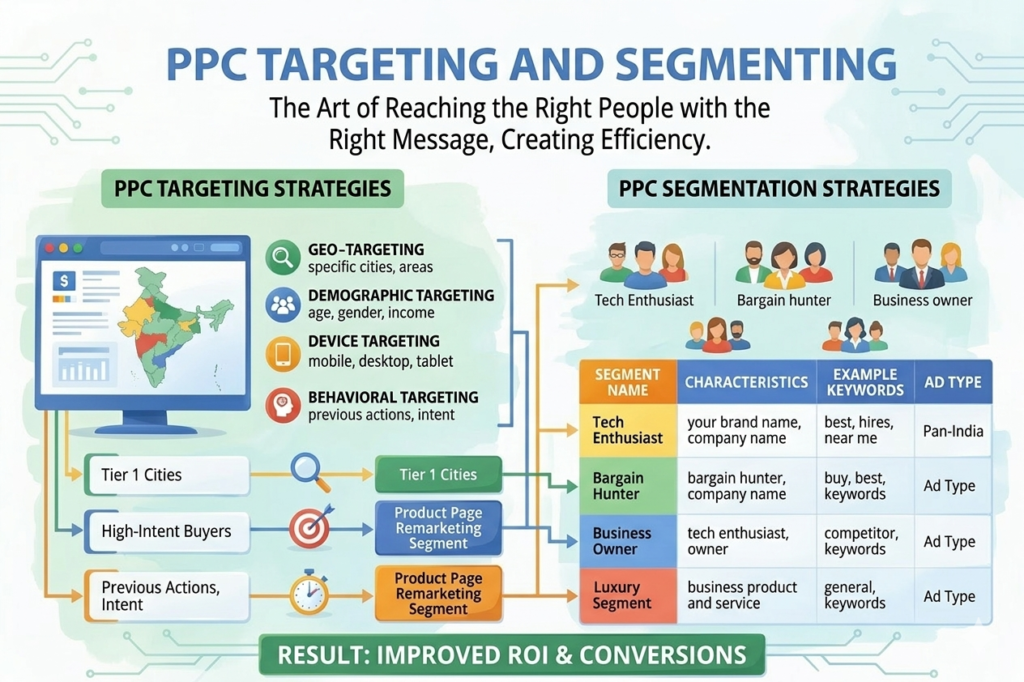
Audience Targeting & Segmentation in PPC (Reach the Right People)
After building your PPC strategy, the next step in how to do PPC marketing effectively is targeting the right audience. No matter how good your ads are, if they are shown to the wrong people, you will waste your budget.
In this part of the ultimate guide to PPC marketing, you’ll learn how audience targeting and segmentation help you reach the right users, improve conversions, and maximize ROI.
Why Audience Targeting is Important?
Audience targeting allows you to show your ads only to people who are most likely to be interested in your product or service. Instead of targeting everyone, you focus on a specific group based on their behavior, interests, and demographics.
For example, if someone is searching for how does pay per click work, they are likely interested in digital marketing. Showing them a PPC course ad will be much more effective than showing it to a random audience.
- “Audience targeting segmentation diagram”
- “Target vs broad audience comparison”
Custom Audience (Highly Targeted Users)
Custom audiences are users you already know or have interacted with your business. This includes website visitors, app users, or people who have engaged with your content.
This type of targeting is very powerful because these users are already familiar with your brand. As a result, they are more likely to click and convert compared to cold audiences.
Example:
- People who visited your blog on how does pay per click work
- Users who clicked your ads but didn’t convert
Best Use:
- Retargeting campaigns
- Warm audience engagement
Lookalike Audience (Find Similar Users)
Lookalike audiences help you reach new people who are similar to your existing customers or audience. Platforms like Facebook and Google use data to find users with similar behavior and interests.
This is one of the best ways to scale your campaigns because you are targeting users who are likely to be interested in your offer.
Example:
- People similar to users who signed up for your PPC course
- Users with similar interests in digital marketing
Best Use:
- Scaling campaigns
- Expanding reach
Demographic Targeting
Demographic targeting allows you to filter users based on basic characteristics such as age, gender, income, and education.
This helps you narrow down your audience and show ads to people who are more relevant to your business.
Example:
- Age: 18–30 (students learning digital marketing)
- Gender: All
- Location: India
Best Use:
- Course promotion
- Product targeting
Behavioral Targeting
Behavioral targeting focuses on user actions and online behavior. This includes what users search for, the websites they visit, and their purchase habits.
This is one of the most advanced targeting methods in PPC because it helps you reach users based on real intent.
Example:
- Users searching for how to do PPC marketing
- People visiting marketing-related websites
Best Use:
- High-intent targeting
- Conversion campaigns
Audience Targeting Comparison Table:-
| Targeting Type | Description | Best For | Conversion Potential |
|---|---|---|---|
| Custom Audience | Existing users | Retargeting | High |
| Lookalike Audience | Similar users | Scaling | Medium–High |
| Demographic | Age, gender, etc. | Basic targeting | Medium |
| Behavioral | User actions & interests | High-intent users | High |
PPC Budget Planning & Cost Control
How to Plan and Control PPC Budget for Maximum ROI?
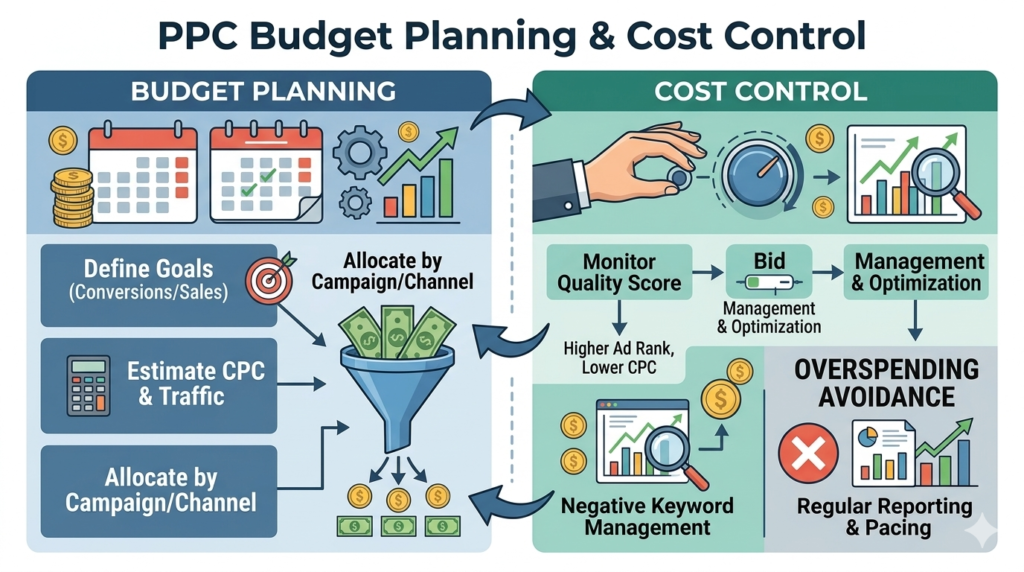
| Topic | Explanation | Example / Formula | Pro Tip |
|---|---|---|---|
| Daily Budget | Daily spend control kore | ₹300/day = ₹9000/month | Beginners der jonno best |
| Monthly Budget | Overall planning er jonno use hoy | ₹9000/month | Campaign-wise divide koro |
| Cost Control | Cost komate optimization korte hoy | Pause low-performing ads | High-performing keyword e focus koro |
| Avoid Waste Clicks | Irrelevant click theke loss hoy | Negative keywords use koro | GEO targeting (India/Kolkata) use koro |
| ROI Calculation | Profit measure korar jonno use hoy | ROI = (Profit ÷ Cost) × 100 | Always ROI track koro |
| ROI Example | Practical calculation | ₹1000 spend → ₹3000 revenue = 200% ROI | High ROI = successful campaign |
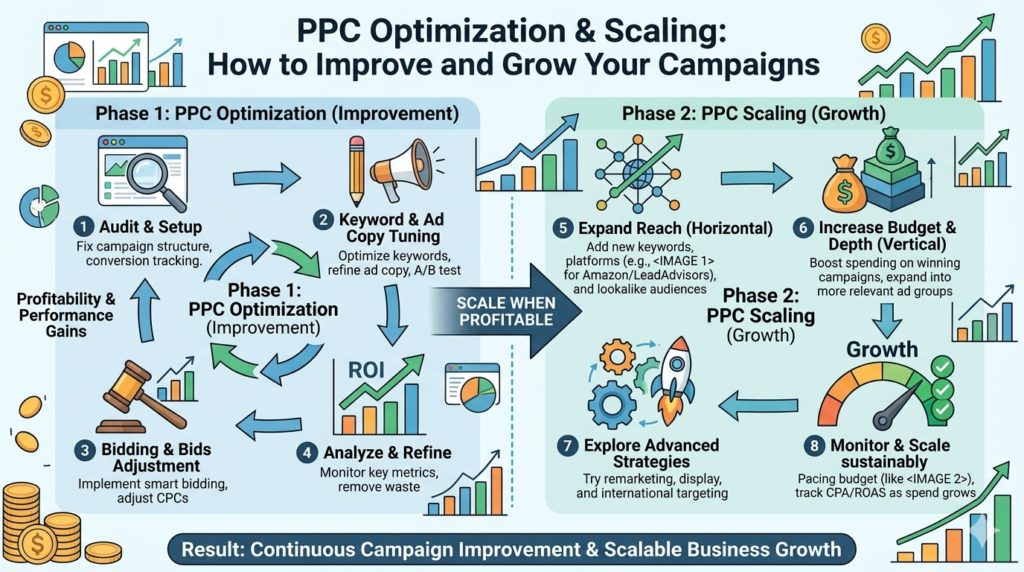
What is PPC Optimization and Scaling?
PPC optimization means improving your campaign performance by analyzing data and making smart changes. Scaling means increasing your budget and reach on campaigns that are already performing well.
Together, these strategies help you reduce cost, increase conversions, and grow your business efficiently.
How to Improve and Grow Your Campaigns ?
Test → Analyze → Improve → Scale → Repeat
Step 1: A/B Testing (Stop Guessing, Start Testing)
Most beginners make one ad and hope it works. But in reality, you should always test multiple versions.
Create 2–3 variations of your ad with:
- Different headlines
- Different CTAs
- Slightly different messaging
Example:
Ad 1: Learn How Does Pay Per Click Work Today
Ad 2: The Ultimate Guide to PPC Marketing – Start Now
Step 2: Ad Optimization (Make Your Ads Better)
Once you find what works, the next step is to improve it further. This is ad optimization.
Instead of changing everything, focus on small improvements:
- Add stronger power words
- Improve your CTA (Buy Now, Get Offer)
- Match ad copy with user intent
Think like this:
Good ad → Better ad → Best ad
Small changes can lead to big results in PPC.
- “Ad improvement before vs after visual”
Step 3: Keyword Refinement (Clean Your Targeting)
Not all keywords will give results. Some bring clicks but no conversions.
So, you need to continuously refine your keywords:
- Remove low-performing keywords
- Add high-converting keywords
- Use negative keywords to block waste traffic
Example:
Instead of broad keyword → PPC marketing
Use → how to do PPC marketing step by step
Step 4: Scaling Winning Campaigns (Grow Smartly )
Now comes the most exciting part—scaling 🚀
Once you find a campaign that is working, don’t just leave it… grow it.
How to Scale Smartly:
- Increase budget slowly (10–20%)
- Expand to new audiences
- Target more locations
Example:
If your campaign on how does pay per click work is performing well →
Increase budget + target more cities in India
Blog Author
Jit pal (SEO specialist , Digital marketer )